UVCS
is the Ultraviolet Coronagraph Spectrometer,
an instrument flying on the
Solar
and Heliospheric Observatory (SOHO)
spacecraft. SOHO, a joint mission between NASA and the
European Space Agency, was launched in December 1995
with the goal of solving some long-standing mysteries
about
our Sun.
SOHO orbits the Sun at the
L-1 Lagrange point between the Earth and the Sun,
which gives it an unobstructed, 24-hour-a-day view of
the Sun and its surrounding layers of ionized gas. SOHO
continues to be an extremely successful mission, and we
are continuing to learn more about the Sun as we see
more of its 11-year
solar cycle with
SOHO.
Click on the small images below for larger images:
|

|

|
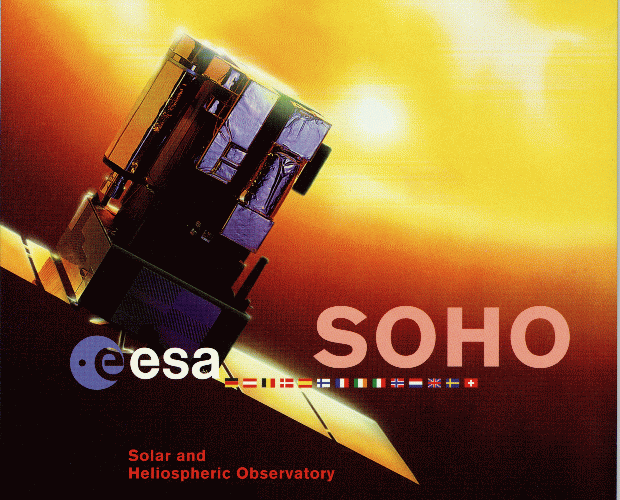
| Artist's conception of SOHO in
space |
UVCS in the lab before it was
attached to the spacecraft |
SOHO prior to launch with UVCS
displayed in front (gold cylinder) |
The goal of the UVCS mission is to provide a detailed
description of the extended
solar corona that can be used to address a broad
range of scientific questions regarding the
heating of the corona and the generation of the
solar wind. UVCS makes measurements of the solar
corona between 1.5 and 10 solar radii (measured from Sun
center), which is the range of heights where the solar
wind particles undergo most of their acceleration. The
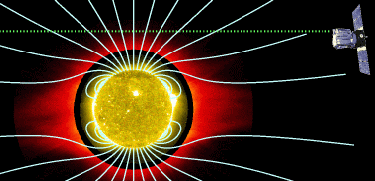
image below shows a typical ``line of sight'' observed
by UVCS through the extended corona. The yellow image is
the disk of the Sun in ultraviolet light (as seen by the
EIT instrument on SOHO). This light is blocked out
by UVCS, which only sees the red parts in the image
below.
The reason that an instrument like UVCS is needed to
measure the properties of the ionized gas in the
extended solar corona can be understood by breaking down
the UVCS acronym:
UV
stands for ultraviolet, which is the
range of wavelengths of light that UVCS observes (500 to
1300 Angstroms). Why observe the Sun in ultraviolet
light? This is the primary range of wavelengths that the
hot plasma of the
solar corona (with a temperature of approximately 1
million K) emits its light. The visible
photosphere of the Sun, in contrast, has a
temperature of only about 6000 K, and thus emits most of
its light at visible wavelengths. Because the Earth's
atmosphere blocks out most of the ultraviolet light that
tries to enter from above, we need to send UV telescopes
up into space to be able to see this component of the
spectrum.
C
stands for coronagraph, which is an
instrument designed to block out the bright ``disk'' of
the Sun so that the much dimmer corona can be viewed
clearly. The corona is thousands to millions of times
less bright than the solar disk, so just a tiny amount
of ``contamination'' of light from the disk can ruin an
observation of the corona.
Traditionally,
total solar eclipses have been the only way to block
out enough of the light of the Sun to see the corona. In
the 1930s, though, Bernard Lyot of France invented the
coronagraph by placing an opaque, circular ``occulting
disk'' in the middle of the light-path of a
solar-viewing telescope, to take the place of the Moon.
In the 1970s, John Kohl and colleagues at the
Smithsonian Astrophysical Observatory developed
coronagraphs that can view solar ultraviolet light, and
flew these ``UVCS prototypes'' on rockets and eventually
on the Shuttle-carried
Spartan 201 payload in the 1990s. UVCS and its
earlier relatives use not one, but two
occulting surfaces, positioned at different places along
the light path, to block out as much of the light from
the solar disk as possible.
S
stands for spectrometer, which is an
instrument that spreads out light into its component
wavelengths so the complete spectrum (often called the
``spectral energy distribution'' of light) can be
measured. In nature, sunlight can be spread into its
component wavelengths by the water molecules in the
Earth's atmosphere (causing
rainbows) or by passing through transparent
materials that act as
prisms. UVCS uses a reflecting
diffraction grating to spread out the ultraviolet
light from the corona into its component wavelengths.
The spectrum of light contains much more information
about the ionized gas, or plasma, than just images could
convey. This is especially true for the extended solar
corona that UVCS observes. Scientists are accustomed to
thinking about rather high-density gases and
plasmas, for which there are very frequent collisions
between the various atoms, ions, and electrons. These
collisions create a state of equilibrium between the
different types of particles, which undergo frequent
enough collisions to share their energy (thus all
``agreeing'' upon a common flow speed and temperature).
But for the very low-density corona, collisions
are so infrequent that each type of particle can have
its own independent flow speed and temperature,
depending on what process is doing the accelerating and
heating! These properties are revealed in
spectral lines, i.e., sharp features in the spectrum
that arise when a bound electron in an atom or ion drops
down from an excited energy level to a level with lower
energy. This energy is released in photons of a specific
frequency, and the
Doppler shifts of these photons allow us to probe
the motions of each type of atom or ion in the corona.
The other pages on this web site, as well as many of
the links highlighted above, provide much more
information about
UVCS, how
it works, and what kinds of scientific discoveries it
has made.
|