Tropospheric Ozone Profiles From Ground-based UV Measurements
Liu, X., K. Chance, C.E. Sioris, M.J. Newchurch, T.P. Kurosu, Tropospheric ozone profiles from a ground-based ultraviolet spectrometer: a new retrieval method, Appl. Opt., 45(10), 2352-2359, 2006. [Full text (pdf)]
The first technique for measuring O3 profiles from ground-based measurements in the UV is the Umkehr technique [Gotz, 1931, 1934], and it has been used for routine observations of O3 trends from both Dobson and Brewer instruments. In this technique, ratios of zenith-sky radiances at two wavelengths in the UV, one strongly and the other weakly O3 absorbing, are measured with the solar zenith angle varying from 60 to 90 during the twilight [Mateer and Deluisi, 1992]. Measured total O3 column from Dobson or Brewer measurements are used to constrain profiles. The Umkehr technique mainly contains information about the vertical distribution of O3 in the stratosphere, with about four independent pieces of information (i.e, significant eigenvectors) at 20-40 km [Mateer, 1965]. Only limited information is in the troposphere, which is provided by the total O3 measurement. In addition, the Umkehr observation lasts about two hours and is restricted to the sunset and sunrise periods.
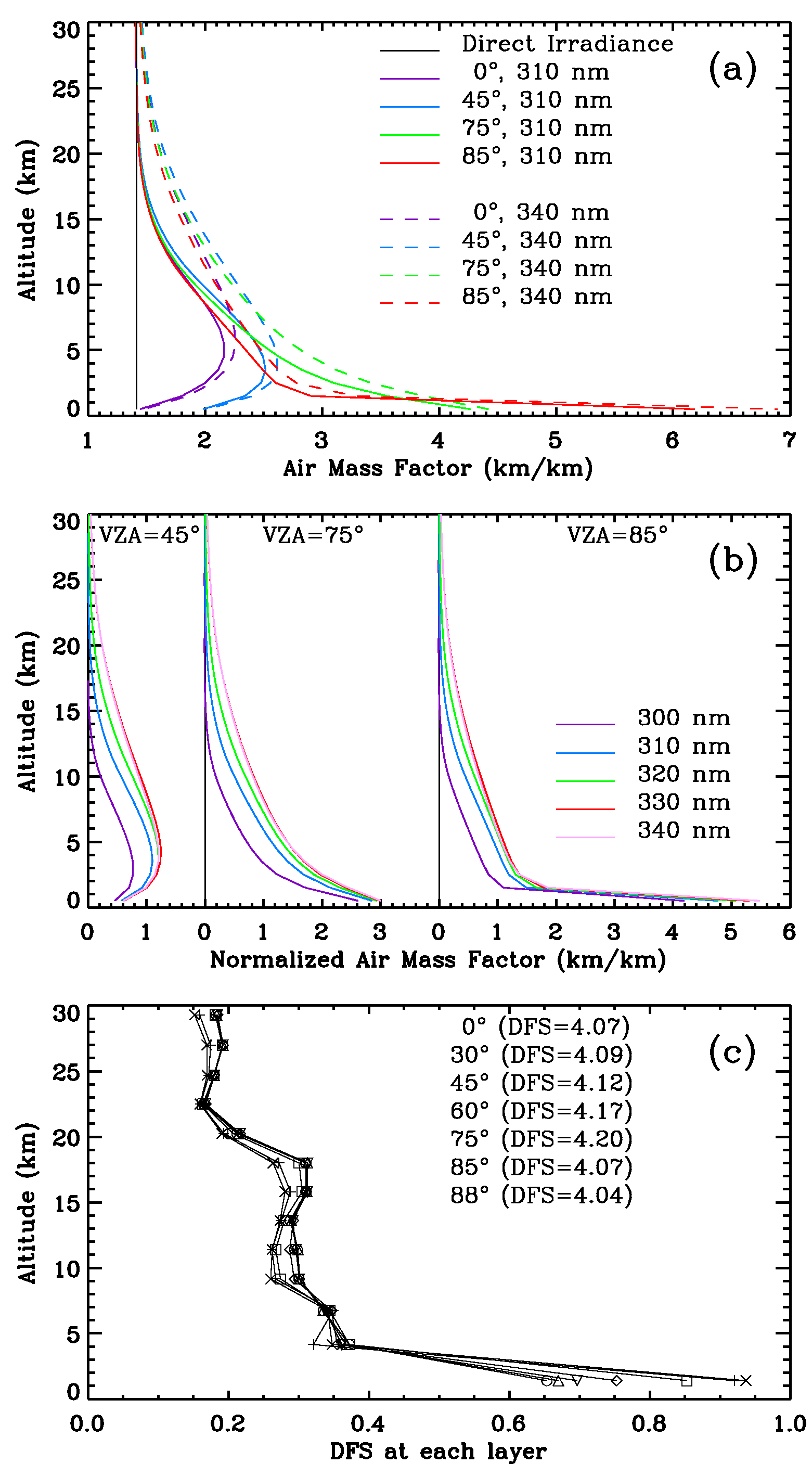
We presents a new method to retrieve tropospheric O3 profiles from ground-based UV spectra in the Huggins bands (300-340 nm) at three viewing zenith angles (VZAs) using the optimal estimation technique. This method refines the idea of using diffuse radiances and direct irradiances by Jiang et al.[1997] to derive tropospheric O3 profiles in the troposphere and extends the method of Liu et al.[2004] from airborne UV spectra to ground-based spectra. Measurements are normalized to direct-sun irradiances or zenith-sky radiances, so no external solar reference is needed. Total O3 is simultaneously measured using the Dobson or Brewer method and is used to constrain the profile. The altitude-dependent, wavelength-dependent, and viewing angle-dependent photon path lengths in the troposphere and lower stratosphere provide the height-resolved O3 profiling information [Figure 1].
|
|
Figure 1. (a) Air Mass Factors (AMFs) for direct-sun irradiance, radiances at 310 and 340 nm for zenith and three view zenith angles(VZA) (45º, 75º and 85º). (b) AMFs for normalized radiances at 300, 310, 320, 330, and 340 nm for VZAs 45º, 75º and 85º. (c) Profiles of Degrees of Freedom for Signal (DFS) using radiance spectra at VZAs 0º, 30º, 45º, 60º, 75º, 85º, and 88º, respectively. The total DFS is also shown in the parentheses. Surface albedo is assumed to be 0.1; the solar zenith angle is 45º. |
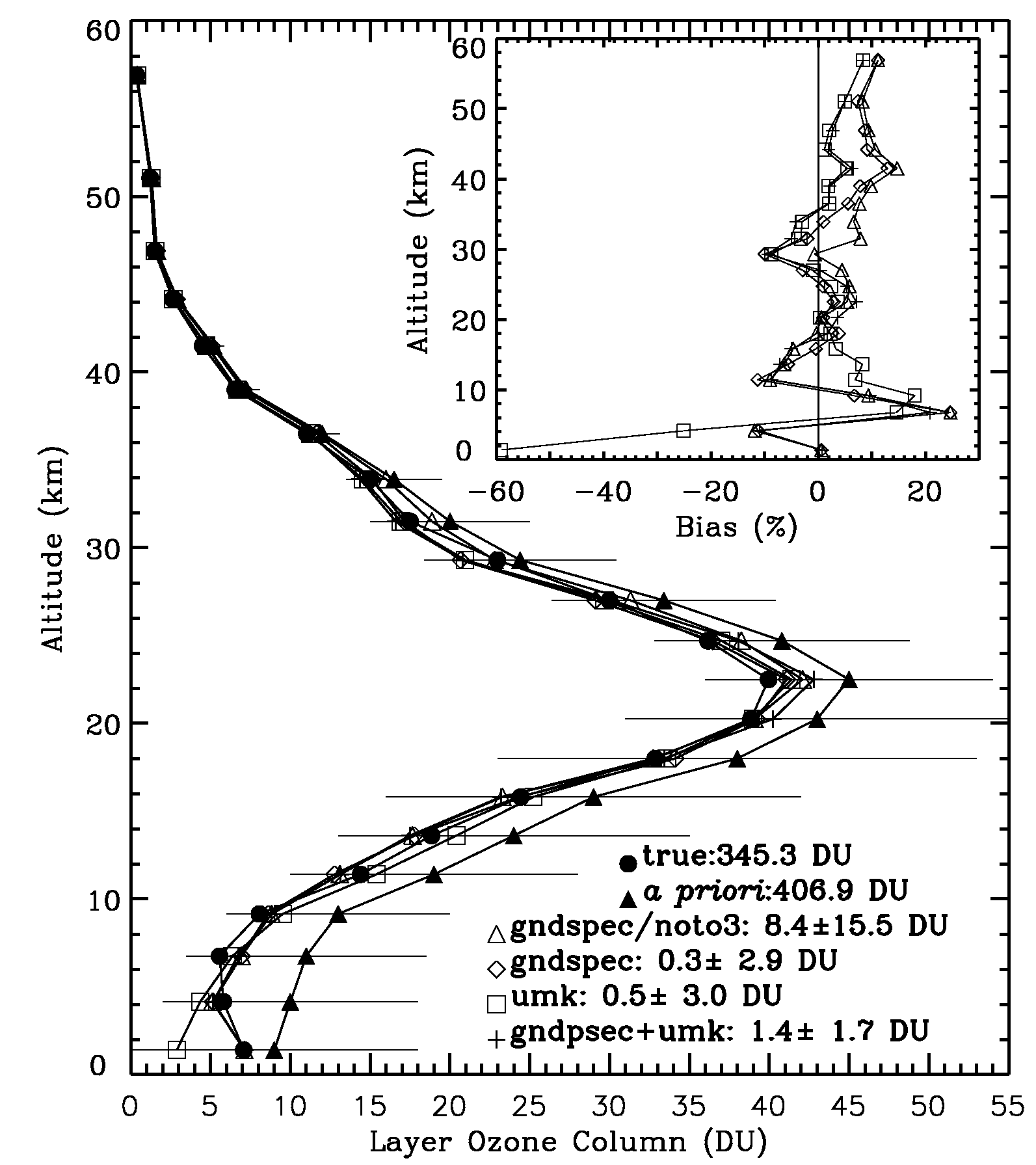
This technique measure O3 in the troposphere and lower stratosphere with vertical resolutions ranging from ~3 km near the surface to ~10 km at 20 km and could be readily combined with the Umkehr technique to measure O3 profiles both in the troposphere and the stratosphere [Figure 2, Figure 3].
 |
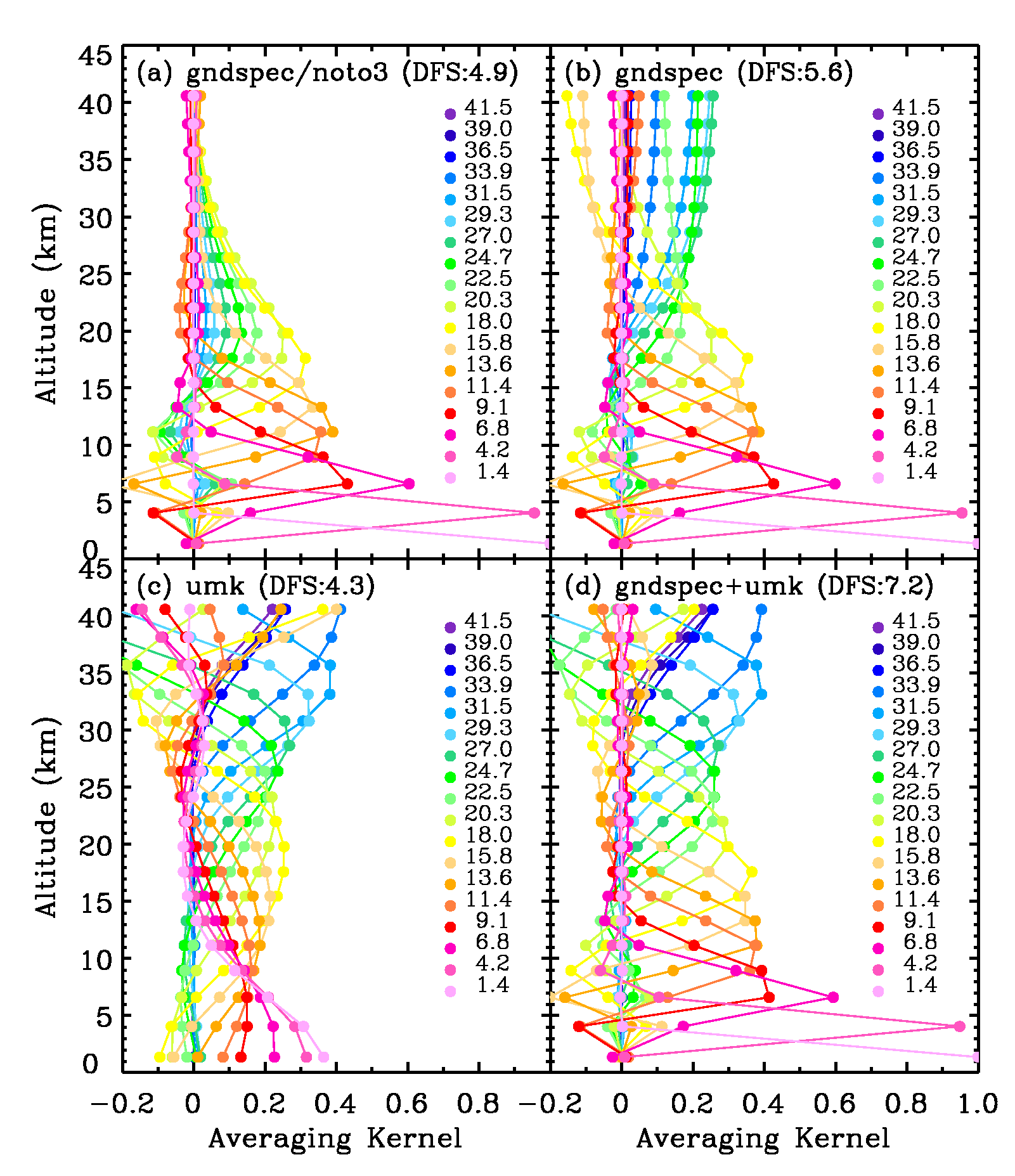 |
| Figure. 2. True, a priori, and retrieved O3 profiles four cases: ground-based spectroscopic measurements without total O3 constraints (i.e., "gndspec/noto3"), ground-based spectroscopic measurements with total O3 constraint (i.e., "gndspec"), standard Umkehr measurements (i.e., "umk"), and combination of ground-based spectroscopic measurements and Umkehr measurements (i.e., "gndspec+umk"). The actual total O3 is indicated as "true" and the bias and retrieval error in total O3 are indicated for each retrieval. The a priori standard deviations are plotted as error bars. The inset shows the relative bias for the four retrievals. | Figure. 3. Averaging kernels for using (a) "gndspec/noto3", (b) "gndspec", (c) "umk", and (d) "gndspec+umk". The total DFS is also shown in the parentheses. Each line refers to the sensitivity of retrieved O3 at each layer to the perturbed O3 at the layer indicated in the legend. |
This technique can be used to accurately measure diurnal variation of tropospheric ozone under remote regions as well as highly-polluted regions [Figure 4].
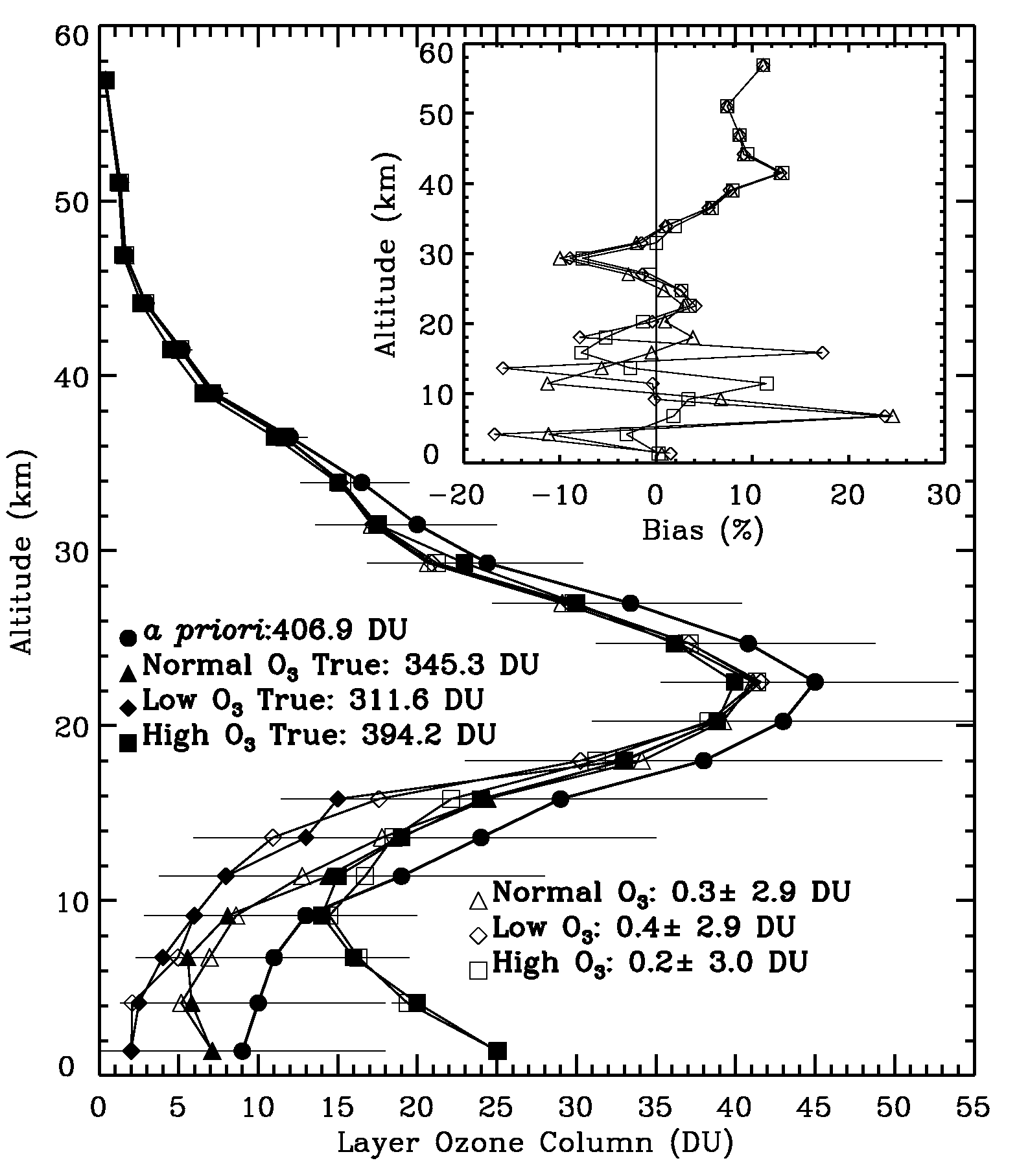 |
Figure 4 Similar to Figure 2 but for retrievals from ground-based spectroscopic measurements under three conditions, the base case and two modified cases representing low and high tropospheric O3 conditions, respectively. The low tropospheric O3 case has a tropospheric O3 column of 22.5 DU and has an average O3 mixing ratio of ~10 ppbv in the near-surface layer; the high tropospheric O3 case has an tropospheric O3 column of 90.0 DU and has an average O3 mixing ratio of ~125 ppbv in the near-surface layer. |
References
Gotz, F.W.P., Zum Strahlungsklima des Spitzbergensommers. Strahlugns-und Ozonmessungen in der Konigsbucht 1929, Gerlands Beltr, 31, 119-154, 1931.
Gotz, F.W.P., A.R. Meetham, and G.M.B. Dobson, The vertical distribution of ozone in the atmosphere, Proc. Roy. Soc. London, A145, 416-446, 1934.
Jiang, Y., Y.L. Yung, and S.P. Sander, Detection of tropospheric ozone by remote sensing from the ground, J. Quant. Spectrosc. Radiat. Transfer, 57, 811-818, 1997.
Liu, X., C.E. Sioris, K. Chance, T.P. Kurosu, M.J. Newchurch, R.V. Martin, and P.I. Palmer, Mapping tropospheric ozone profiles from an airborne UV/Visible spectrometer, submitted to Appl. Opt., 2004.
Mateer, C.L., On the information content of Umkehr observations, J. Atmos. Sci., 22, 370-381, 1965.
Mateer, C.L., and J.J. DeLuisi, A new Umkehr inversion algorithm, J. Atmos. Terr. Phys., 54, 537-556, 1992.
Last updated on 04/04/2006 .