Debris Disk Evolution
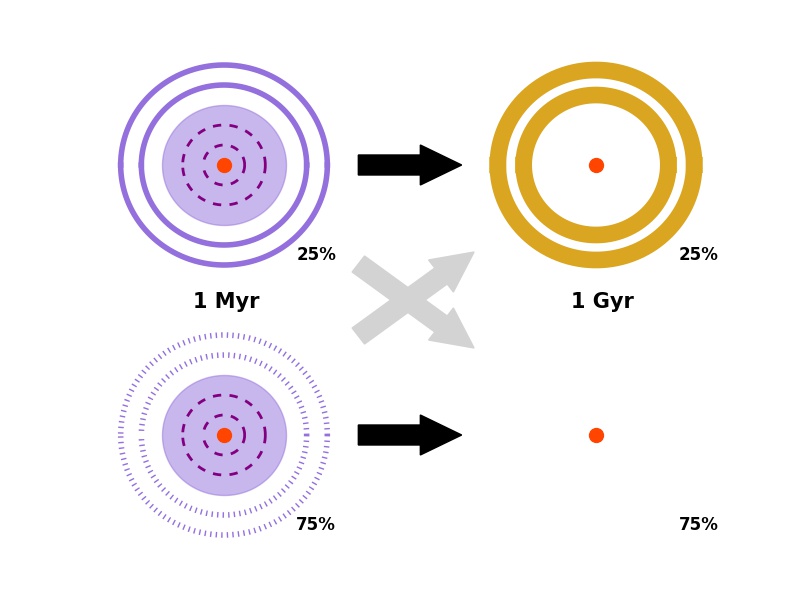
The schematic above illustrates possible evolutionary paths to a debris disk. Young stars with ages of a few Myr or less have two broad classes of disks as shown in the two panels on the left side of the graphic. All have a compact disk with a radius of 20-40 au. In roughly 25%, bright rings of gas and dust lie outside the compact disk; the rest may have rings of gas and dust that are too faint to detect. Stars with ages of 100~Myr and older (illustrated in the two panels on the right side of the graphic) may have a set of debris rings or a set of planets or both. We collect observational data and perform numerical calculations to see which paths are most commonly followed. So far, it seems that rings evolve along all four paths from the two left graphics to the two right graphics. The two horizontal paths indicated with heavy black arrows, from bright rings to debris disks and from compact disks to planetary systems, seem more common than the two diagonal paths indicated with lighter arrows.