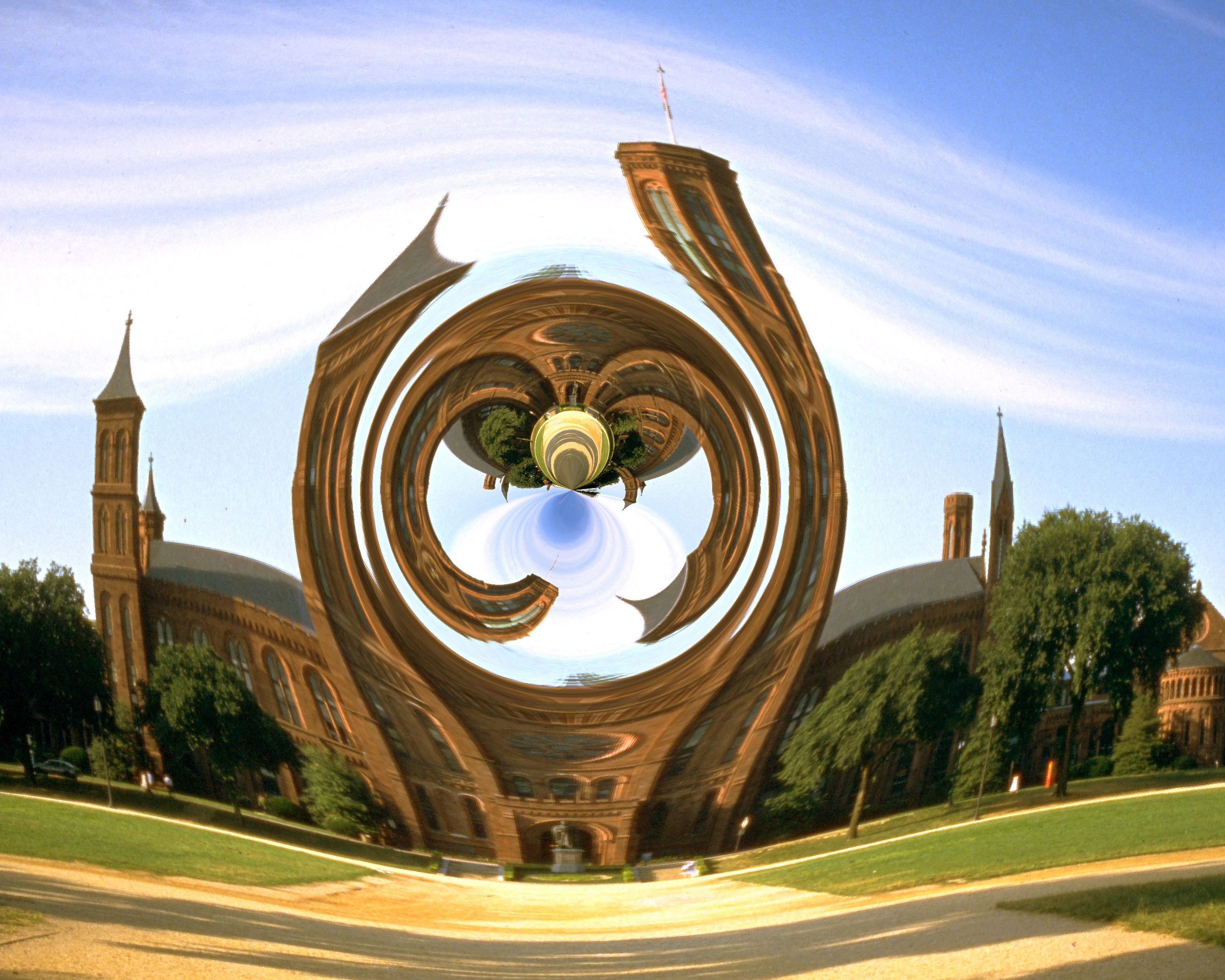
Astronomers at the American Astronomical Society meeting in Washington, D.C. presented a whimsical image of the appearance of the Smithsonian Castle on the National Mall if it were viewed through the distorting influence of an imaginary black hole, i.e. a "gravitational lens". This computer-generated image was presented by Dr. Brian McLeod of the Harvard-Smithsonian Center for Astrophysics (CfA), in Cambridge, MA, along with colleagues from the CfA and the University of Arizona, during a presentation of recent observations of astronomical gravitational lenses made with the Hubble Space Telescope.
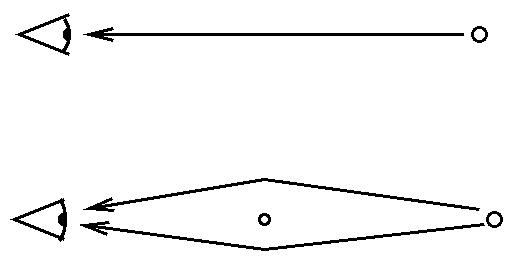
Gravitational lensing is a phenomenon predicted by Einstein's Theory of General Relativity, where light rays emanating from a background object are bent by the gravitational field of a foreground object, thus distorting the appearance of the background object. Researchers from the Harvard-Smithsonian Center for Astrophysics and the University of Arizona (UA) in Tucson are using the Hubble Space Telescope to study some two dozen examples of this phenomenon. This project has been dubbed "CASTLeS", the CfA-Arizona Space Telescope Lens Survey. The members of the CASTLeS team are Drs. Emilio Falco (CfA), Christopher Impey (UA), Christopher Kochanek (CfA), Joseph Lehar (CfA), McLeod, Hans-Walter Rix (UA), and graduate student Chien Peng (UA). The lenses being studied by the CASTLeS team arise from the gravitational field of a galaxy that bends the light from a more distant galaxy or quasar. The results of this study will be used to learn more about the properties of distant galaxies, and to determine the Hubble Constant, i.e. the rate at which the Universe is expanding. Images from the CASTLeS project can be found at http://cfa-www.harvard.edu/castles.
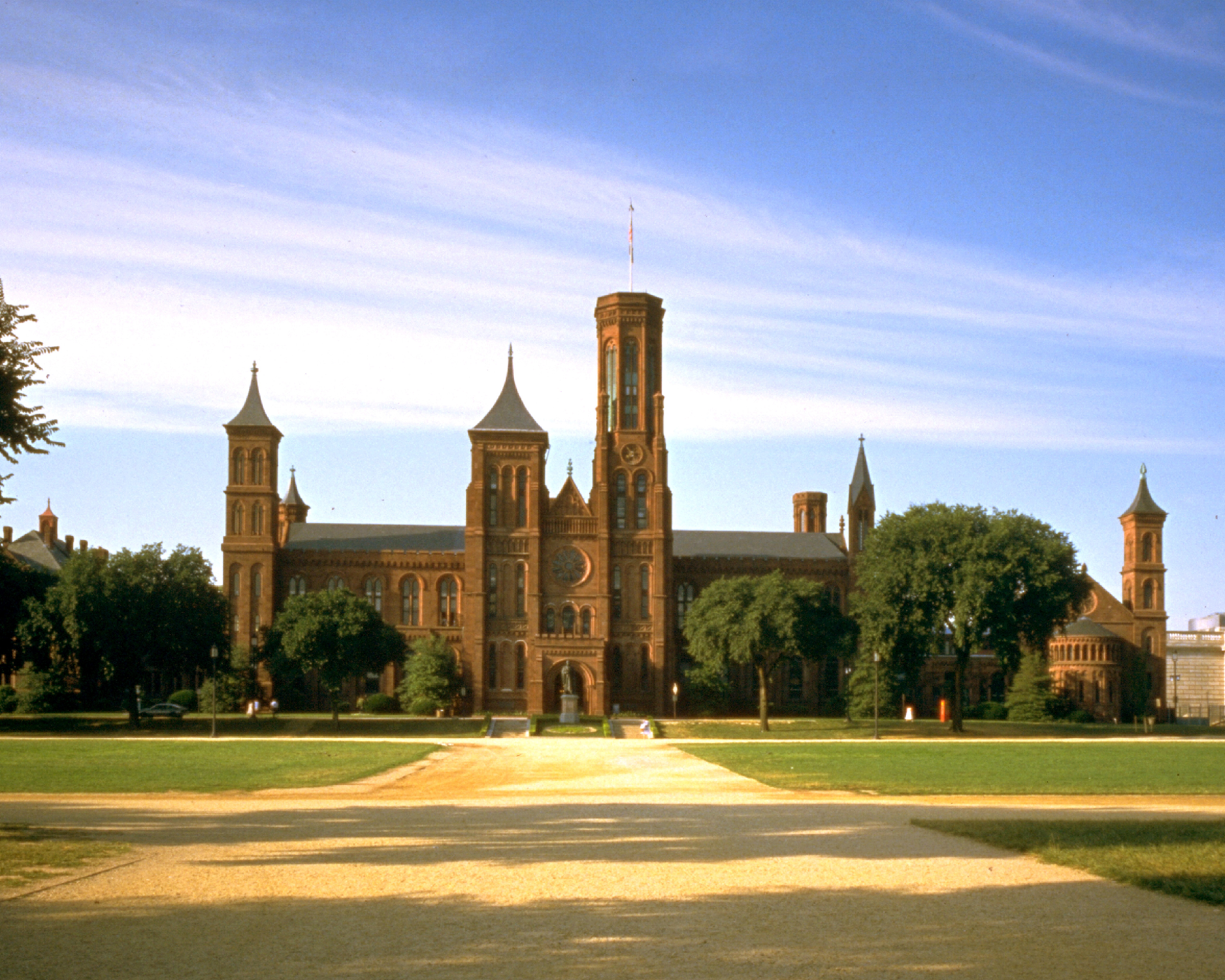
To illustrate gravitational lensing in a more familiar setting, McLeod started with a digitized photograph of the Castle on the National Mall. He then used computer software originally written for analyzing astronomical gravitational lenses to distort the image as if there were a black hole between the camera and the Castle. The imaginary black hole has the mass of the planet Saturn. Because of the gravitational lensing effect, each point in the original image appears twice in the distorted image, once in the outer part of the image, and once again in the inner part, but upside down and mirror-reversed. Note that if there were really a black hole of this size floating above the Mall, the Castle and its surroundings would be ripped apart by the intense gravitational forces generated by the black hole.
CAPTION: Cartoon showing how gravitational lensing can produce multiple images. In the top panel, no lens exists, so light rays from the source arrive at the eyeball from only one direction. In the bottom panel, a foreground lens bends the light rays so that light from the source arrives from more than one direction.
Click on image for high resolution version.
CAPTION: View of the Smithsonian Institution Castle on the National
Mall, Washington, D.C. Photo Credit: Smithsonian Institution
Click on image for high resolution version.
CAPTION: The Castle on the National Mall as seen if there were an imaginary black hole with the mass of Saturn floating above the Mall, thus distorting the view of castle though gravitational lensing. Photo Credit: Brian McLeod, Harvard-Smithsonian Center for Astrophysics
EDITORS: These images can be obtained over the Internet via http://cfa-www.harvard.edu/~bmcleod/castlepress.html
For More Information:
Brian McLeod (617)495-7023 bmcleod@cfa.harvard.edu
Emilio Falco (617)495-7131 efalco@cfa.harvard.edu
Christopher Impey (520)621-6522 cimpey@as.arizona.edu
Christopher Kochanek (617)496-8380 ckochanek@cfa.harvard.edu
Joseph Lehar (617)496-6848 jlehar@cfa.harvard.edu
Hans-Walter Rix (520)621-6027 rix@as.arizona.edu
Chien Peng cyp@as.arizona.edu