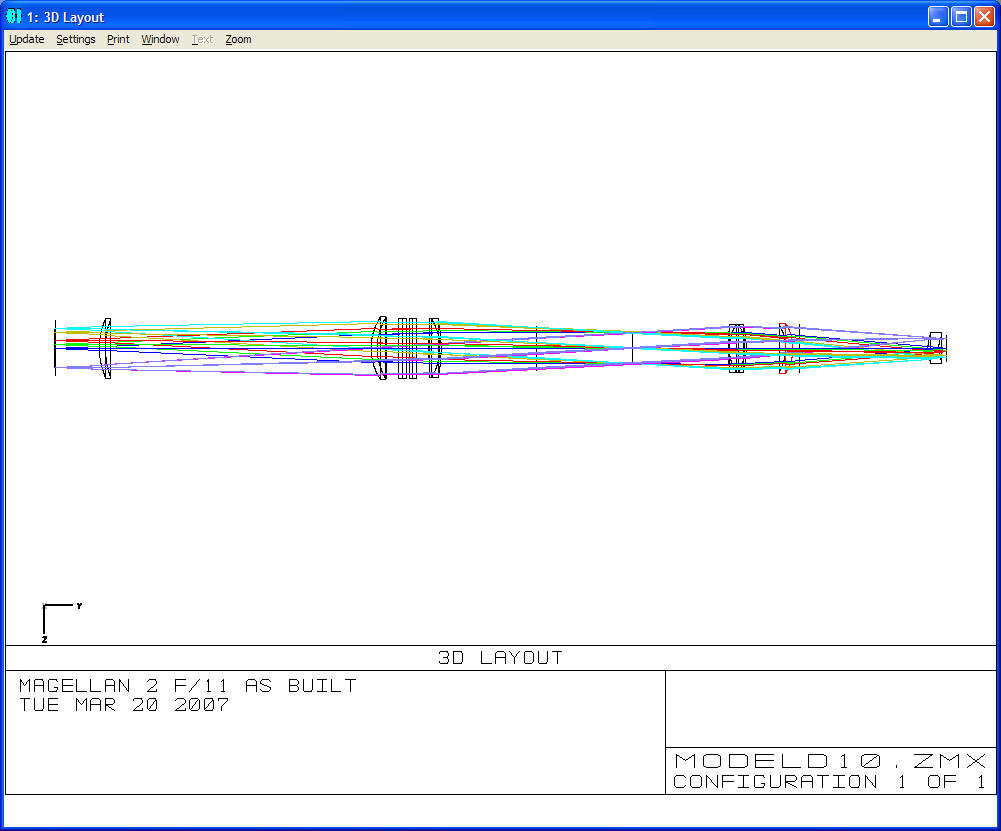
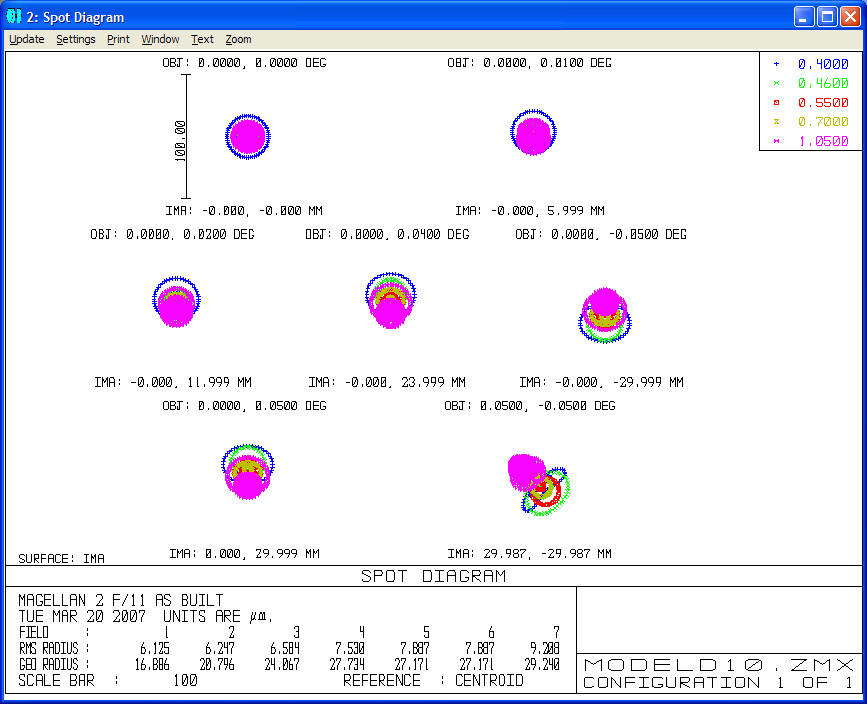
Four optical designs.
Here are four alternate optical designs, based on new design
work done since the 13 December 2006 design review, and including suggestions
from Steve Shectman. The ZEMAX files can be found
here. The SAFE8.AGF glass catalog is
needed for these ZEMAX designs—this is the Ohara
catalog with the obsolete glasses deleted, the glasses with low transparency at
4000Å deleted, and a few additional glasses added in.
All the designs meet PISCO optical and mechanical
specifications.
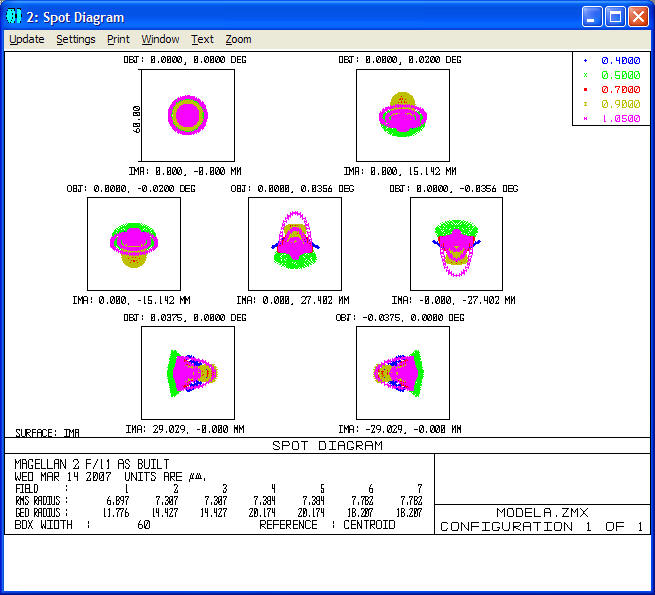
Design A:
This design is a lightweighted version, with thinner lenses,
of the design shown at the 13 Dec 2006 design review.
- 4.5 arcminutes square field mapped onto 60 mm square CCD.
- only low Coefficient of Thermal Expansion (CTE) glasses (CTE
< 9 × 10⁻⁶ °C-1 ), with low fragility, low stainability.
- The largest lens is 155 mm in diameter.
- Three aspheric surfaces.
- Two singlet field lenses, the ADC, a triplet, a doublet,
the dichroics, a filter, a triplet, a doublet, and two singlets.

Attached to a Magellan model where Magellan has no Atmospheric
Dispersion Compensator (ADC), the image quality is high.
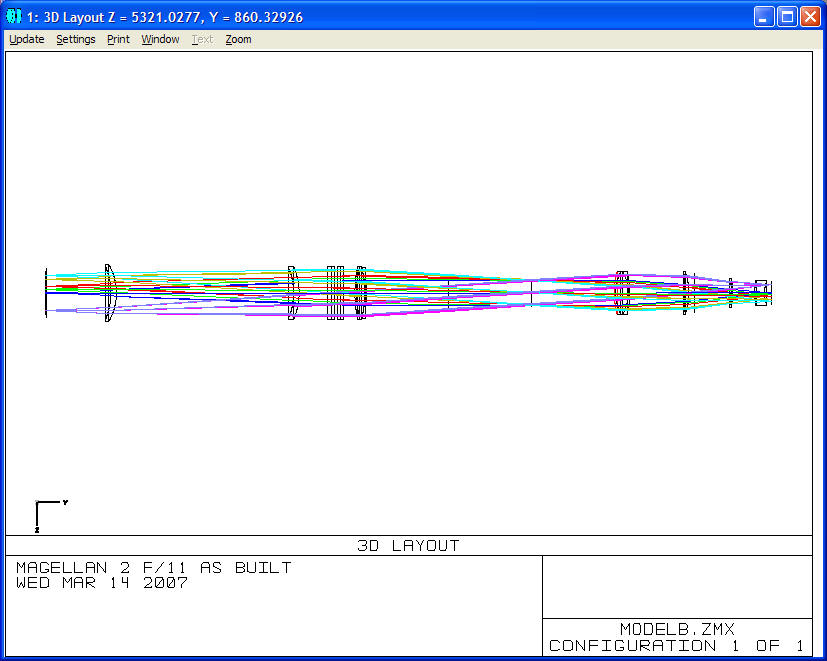
Design B:
This design is a development of Steve Shectman's design.
It's been modified to fit it into the PISCO physical configuration, and to
reduce the size of the lenses using a field lens.
- 6 × 6 arcminutes square field mapped onto 60 mm
square CCD.
- The two "objective lenses" are triplets made from Calcium
Fluoride sandwiched between two pieces of S-LAL11. Steve Shectman says
he knows how to make such triplets. They are cemented with a flexible
glue that allows for the difference in CTE.
- The largest lens is 210 mm in diameter.
- No aspheric surfaces.
- Singlet, singlet, the ADC, Calcium Fluoride triplet
sandwich, the dichroics, Calcium Fluoride triplet, singlet, singlet, singlet.
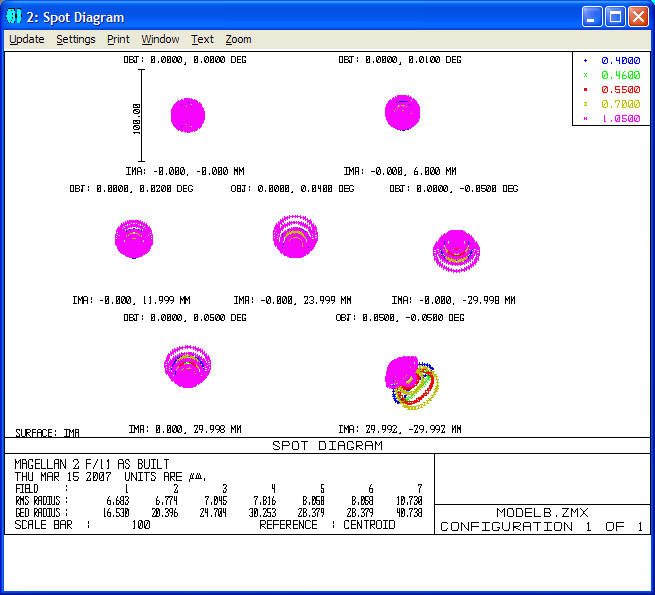
Here is a spot diagram:
Design C:
This design is basically the same as Design B, but uses a
low-dispersion, high-CTE glass, S-FPL53, instead of CaF2. A
variant with S-FPL51 works nearly as well. In this example, the two
triplet objectives are air spaced, so there is no gluing of grossly different
CTEs. It might also be possible to glue the triplets together as in Design
B.
- 6 × 6 arcminutes square field mapped onto 60 mm
square CCD.
- The two "objective lenses" are triplets made from S-FPL53
sandwiched between two pieces of S-LAL14. These have very
different CTEs, and so the design presented here airspaces these triplets.
- The largest lens is 205 mm in diameter.
- No aspheric surfaces.
- Singlet, singlet, the ADC, singlet, singlet, singlet, the
dichroics, singlet, singlet, singlet, singlet, singlet, singlet.
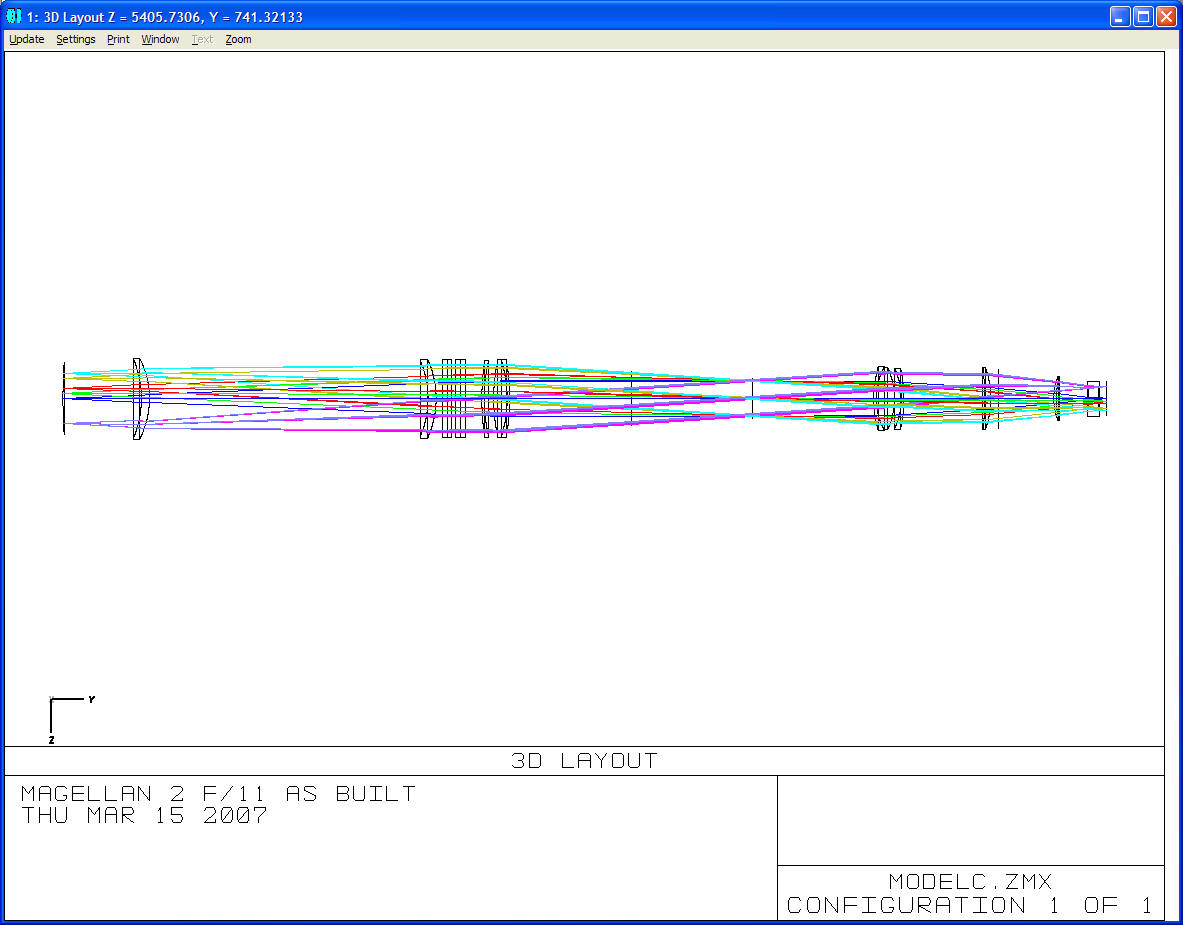
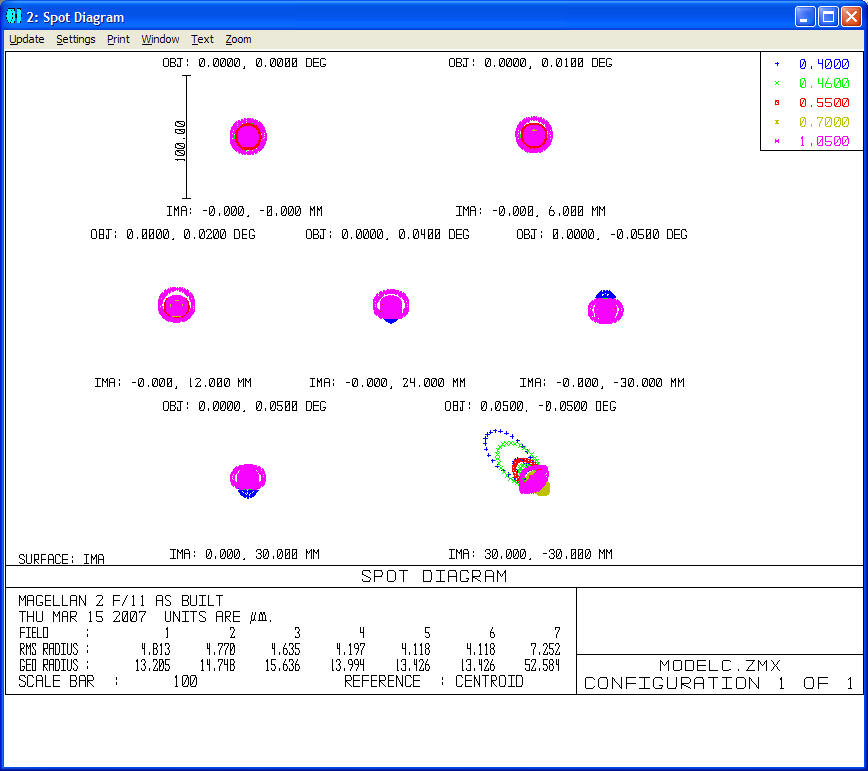
This design is nearly diffraction limited.
Design D:
Uses a
more readily-obtainable low-dispersion, high-CTE glass, S-FPL51, instead of S-FPL53.
Two lenses fewer than Design C, and the image is nearly as good. The first
objective is now a cemented doublet, the second a cemented triplet.
- 6 × 6 arcminutes square field mapped onto 60 mm
square CCD.
- The two "objective lenses" are made from S-FPL51 glued to
S-LAL11 and S-NSL3. These have very
different CTEs, and so gluing presents a technical challenge.
- The largest lens is 204 mm in diameter.
- No aspheric surfaces.
- Singlet, singlet, the ADC, doublet, the dichroics, triplet, singlet, singlet.