|
What governs protostellar mass accretion?
As far as we know, all stars form by gravitationally-driven accretion. However, the high luminosities and high temperatures of massive stars create outward pressure forces that may be competitive with the inward gravitational attraction that drives accretion. How do the radiation pressure of the stellar luminosity on dust grains in the accretion flow and the thermal pressure of hot gas ionized by the high stellar temperature each modify the accretion flow? Progress on this question has been slow because of the difficulty of observing accretion processes around deeply embedded high-mass stars located at large distances.
Observing mass accretion
Observers seek to overcome the difficulties in observing accretion disks by taking advantage of the SMA's high frequency capability and the fact that massive stars heat the surrounding molecular gas. Temperatures of 100 K to more than 1000 K melt the ice mantles of dust grains, drive complex organic chemistry and increase the gas-phase abundances of complex species. Observations of high excitation spectral lines of these complex molecules discriminate the hot gas around the star from the cold gas in the molecular core and reveal the physical state and dynamics of the gas around the protostars, including their accretion flows. SMA observations (Patel et al. 2005; Klaassen et al. 2009; Zapata et al. 2008) of high excitation lines of methyl cyanide (CHi3CN), methanol (CH3OH), sulfur dioxide (SO2) and other complex species have located accretion flows and disks around a number of massive protostars and determined the mass accretion rates (10-3 to 10-2 M yr-1) and rotational velocities (~1 to 4 kms-1). These results suggest that high- and low-mass stars form by generally similar processes, but that the protostellar disks of massive stars are themselves much more massive than their low mass counterparts. This finding of massive disks has further implications for the accretion processes of massive stars.
Mass accretion and stellar multiplicity
Stars of all masses are often found with gravitationally bound companions, but the number of gravitationally bound companions is significantly higher for massive stars. The Trapezium system in the center of Orion is the most famous example, containing eight stars in four binary pairs. Is the high multiplicity of massive stars the result of the clustered formation environment or the high disk densities? SMA observations have found densities in massive protostellar disks high enough that the disk itself is unstable to local fragmentation and the formation of companion stars in the disk (Patel et al. 2005).
Mass accretion and magnetic fields
SMA observations of polarized emission from dust in the accretion flows of high mass stars (Girart et al. 2009; Tang et al. 2009) identify a characteristic hourglass pattern. This coherent bipolar morphology indicates either that accretion disks are aligned with the pre-existing field or that the gas flow during accretion simply drags the field into alignment around the star no matter what the initial field geometry. The same hourglass pattern is observed in SMA observations of low-mass stars. While it is not clear whether the magnetic field is dynamically significant, the comparison of the SMA observations of magnetic fields in both high and low mass stars indicates similar behavior of the magnetic field and a similar formation process in both classes.
Mass accretion and ionization
Massive protostars begin core nuclear-burning while still accreting, and their high stellar temperatures can ionize the surrounding gas and form an HII region inside the accretion flow. Along the mid-plane of the accretion flow, the molecular gas penetrates the HII region, feeding the HII region as well as the star. Perpendicular to the mid-plane, the ionized gas streams off the surface of the rotating molecular flow creating a wide-angle ionized outflow that entrains some of the surrounding molecular gas producing a wide-molecular outflow.
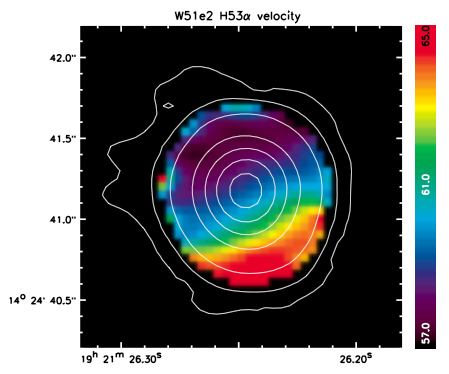
The SMA has two advantages in observing HII regions in that the ionized gas has a much lower optical depth at high frequency and the high frequency radio recombinations are little affected by pressure broadening. Thus SMA observations are able to see deep inside the very small and dense HII regions around the youngest massive protostars and accurately measure velocities. Using the H30α recombination line, SMA observations (Keto & Klaassen 2008; Keto et al. 2008; Weintroub et al. 2008) have measured the density gradients and velocities inside these very small HII regions to determine that the observed supersonic velocities are driven by thermal pressure down steep density gradients maintained by the stellar gravitational field. Observations of one HII region demonstrate the spiral pattern caused by the combination of rotation and outflow in the ionized gas.
 |
 |
| Click here for larger view |
Click here for larger view |
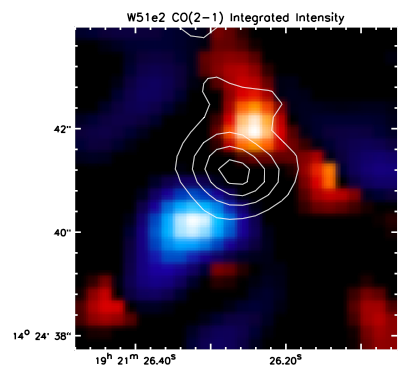
Figure 3: (Left) SMA image of the brightness of the red and blue CO emission of the bipolar outflow associated with the HII region W51e2 (white contours). (Right) Velocities of the H53α recombination line. The apparent velocity gradient is the combination of rotation and outflow of the ionized gas. The two images are on different angular scales. (Keto & Klaassen 2008) |
Mass accretion and bipolar molecule outflows
Both massive and low-mass protostars are associated with bipolar outflows. However, the outflows associated with the most massive stars may be wider and slower than the typical magnetically driven outflows of lower mass stars. The break occurs at a protostellar mass corresponding to spectral type early B, just when a growing protostar begins to develop a significant HII region. What causes the difference? Are the wide-angle outflows around O stars driven by the HII regions expanding off their accretion disks or is the outflow still magnetically driven as in the low mass case, but less collimated for some other reason?
SMA observations have studied many bipolar outflows associated with the more common B-type and later protostars (Qiu et al. 2009; Qiu & Zhang 2009; Zapata et al. 2006) and more recent observations have targeted the molecular outflows of the most massive stars and HII regions (Keto & Klaassen 2008). The high excitation molecular lines observable at the SMA are useful because they show the hotter, more collimated gas in the outflows. The SMA's high angular resolution is able to trace the outflows back to their origins and identify the individual exciting stars even in crowded star-forming regions at large distances.
» Next Page: Summary
« Previous Page
SMA Research
|