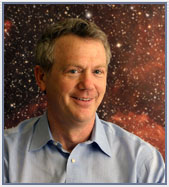
Bob
Kirshner
Watch
QuickTime video:
Big questions
What
can
we know
|
We asked Bob Kirshner,
Professor of Astronomy at the Harvard-Smithsonian Center for Astrophysics
and co-discoverer of the accelerating universe,
about his current research, and also about his thoughts on
what "Big Ideas" were
essential for understanding the structure and evolution of the
universe. Hereare his answers - you can find more information
about many of these topics on the rest of this web site.
Q: What questions about the universe
are you trying to answer?
Well,
the big question I'm working on right now is to try to understand
the expansion of the universe. We've known, since the 1930's
that we live in a universe that is expanding. And the measurements
that I've been working on try to see whether the universe was expanding
at the same rate in the past as it is now. You might expect
that the universe would slow down, because we know there's gravity,
and that gravity was predicted to slow down the cosmic expansion.
...And we found some very surprising results, which
is that the universe does not seem to be slowing down, as you might
expect, but that it's actually accelerating. That the expansion
of the universe has been speeding up over the last five or seven
or ten billion years, so that the present rate of expansion is
higher than the rate was back then.
This is a big surprise, and it means that
there has to be something in addition to the kind of gravity
people have been thinking about for a long time. There has to
be some other property of space which pushes things out.
Q: Are there questions in science
that can't be answered?
You're always
in trouble when you say "Oh, you just can't know about that," you
know? Because the evidence is that as our tools get better
for seeing what the world is, we actually do begin to know about
things. You know, 200 years ago, people thought you just couldn't
know what the stars were made of. But, in fact, we have
a whole story about all of the origin of every chemical element.
And we can see that it really has happened in stars. So,
you know, I think you want to be careful about saying what's impossible
to learn.
Q:
What is your list of "Big Ideas" that help us understand
our place in the universe?
Here's my list of a dozen great ideas...
- Cosmic Expansion - we live in an
expanding universe.
- Cosmic Humility - we're not at the center (though
we are at the Center for
Astrophysics!)
- Cosmic Time - we don't live long
enough to see astronomical systems change (except for supernovae
- we can show Supernova 1987A changing, for example), but the universe
appears to have had a time of beginning, about 14 billion years
ago. This age corresponds to the time for cosmic expansion, stellar
evolution, and is consistent with radioactive clocks in the solar
system.
- Uniformity of Physical Law - calcium
atoms in cheese, the Sun, and in distant galaxies obey the same
rules of quantum mechanics. That's what lets us measure the redshift
of galaxy spectra.
- Distance from apparent brightness -
this idea, that "faint
means far," underpins almost all we know about the cosmic
distance scale.
- Finite Speed of Light - this could not be measured
in any physics lab in the 1600's, but was discovered from astronomical
observation. It gives astronomical observation an historical reach
to see into the past. Part of the evidence for cosmic change comes
from observations of the most distant galaxies.
- Space-Time - only a funny surface in space-time
is accessible to our
observation - here and now, there and then. We can't see what
M31 looked like 7 billion years ago. We don't see what the
galaxies in the Hubble Deep Field look like now.
- Gravitation - the weakest force
dominates the discussion. Cosmic deceleration predicted, cosmic
acceleration discovered. How weird is that?
- Evidence for Dark Matter - we infer the presence
of unseen objects by their
effects. Gravitational force on stars in outer parts of galaxies
implies unseen
matter.
- Energy Budget for the Universe - dark energy, non-baryonic
dark matter,
baryonic dark matter, luminous stuff - does this really add
up? But what is the dark matter, and what is the dark energy?
- Growth of structure - The Cosmic
Microwave Background from the Big Bang is smoother than a baby's
bottom, but the galaxy distribution today has sheets, filaments,
and voids. Astronomers use galaxy maps of present structure, balloon
and satellite measures of the CMB, and numerical computer simulations
of dark matter to figure out how this may have happened under the
force of gravity.
- Technology of observing the
early universe - the
next generation of ground and space-based observatories will
help us answer our current big questions about the universe,
and will no doubt generate new questions.
|



