Wednesday, March 09, 2011, 11:00 am, Pratt Conference Room
Initial Results from the
Herschel Orion Protostars Survey (HOPS)
Dr. Tom Megeath (University of Toledo)
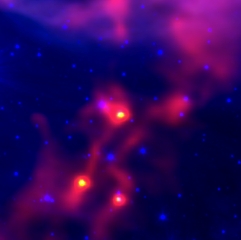
| Space-based IR telescopes are providing a new means for identifying and studying protostars and protostellar evolution, perhaps the least understood phase of stellar evolution. Spitzer surveys of molecular clouds have detected several hundred protostars in the nearest 1 kpc. Determining the physical properties of these protostars requires extensive measurement across the IR spectrum. The Herschel Orion Protostar Survey (HOPS) is a 200-hour open-time key project targeting the Spitzer identified protostars in Orion, probably the largest sample of protostars in a single complex within 1 kpc of the Sun. HOPS is obtaining PACS 70 and 160 micron imaging of 286 Orion protostars and PACS spectroscopy of a subset of 36 protostars, sampling the expected peaks of their spectral energy distributions. The Herschel data are complemented by Spitzer 5-40 micron spectra, high angular resolution near-IR imaging with Hubble and ground-based telescopes, and millimeter observations of the surrounding gas. Although the program is still in its early phases, initial results show that the combination of Herschel, Spitzer and Hubble data is a powerful means for determining the basic properties of protostars (multiplicity, gas infall rate, bolometric luminosity, outflow cavity geometry). In addition, HOPS has made some unanticipated discoveries, including the identification of a hole in NGC 1999, the detection of crystalline silicates in a cold, infalling protostellar envelope, and the detection of new protostars invisible at Spitzer wavelengths. |