Wednesday, October 5, 2011, 11:00 am, Pratt Conference Room
The Berkeley Supernova Ia Program (BSNIP): Dataset and Initial Analysis
Jeffrey Silverman (University of California, Berkeley, Lawrence Berkeley
National Laboratory)
|
I will present spectroscopic data from the Berkeley SuperNova Ia
Program (BSNIP), their initial analysis, and the results of attempts
to use spectral information to improve cosmological distance
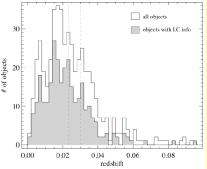
determinations to Type Ia supernova (SNe Ia). The dataset consists of
1298 low-redshift (z< 0.2) optical spectra of 582 SNe Ia observed
from 1989 through the end of 2008. Many of the SNe have
well-calibrated light curves with measured distance moduli as well as
spectra that have been corrected for host-galaxy contamination. I will
also describe the spectral classification scheme employed (using the
SuperNova Identification code, SNID; Blondin & Tonry 2007) which
utilizes a newly constructed set of SNID spectral templates. The sheer
size of the BSNIP dataset and the consistency of the observation and
reduction methods make this sample unique among all other published SN
Ia datasets.
I will also discuss measurements of the spectral features of about one-third of the spectra which were obtained within 20 days of maximum light. I will briefly describe the adopted method of automated, robust spectral-feature definition and measurement which expands upon similar previous studies. Comparisons of these measurements of SN Ia spectral features to photometric observables will be presented with an eye toward using spectral information to calculate more accurate cosmological distances. Finally, I will comment on related projects which also utilize the BSNIP dataset that are planned for the near future. |