Wednesday, June 30, 2010, 11:00 am, Phillips Auditorium
> > > Note change of day and time < < <
Nebulae Around Luminous Blue Variables (LBVs):
A Multi-Wavelength Approach
Dr. Grazia Umana, IRA/INAF (Italy)
| We present the first results of our study of a sample of Galactic LBVs, aimed at contributing to a better understanding of the LBV phenomenon by recovering the mass-loss history of the central object from the analysis of its associated nebula. Mass-loss properties have been derived by a synergistic use of different techniques at different wavelengths to obtain high-resolution, multi-wavelengths maps that trace the different emitting components coexisting in the stellar ejecta: the ionized/neutral gas and the dust. The study of these components provides two kinds of information: the current mass-loss rate, via direct observations of stellar winds (the ionized gas component), and the mass loss history of the central star, by analysis of the dust component/s. Observational evidence of asymmetric mass-loss and possible mutual interaction between gas and dust components has been found by comparing the mid-IR (Spitzer/IRAC, VISIR@VLT) and radio (VLA) images of the nebulae, while important information on the gas and dust composition has been derived from Spitzer/IRS spectra. |
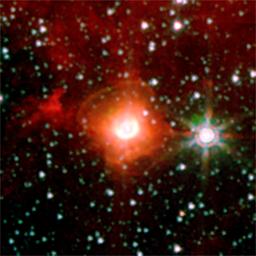
2004 Spitzer IRAC image of HD 168265, a luminous blue variable star