Friday, March 26, 2010, Noon, Phillips Auditorium
Aspherical Supernova Explosions
Dr. Ryan Chornock (CfA)
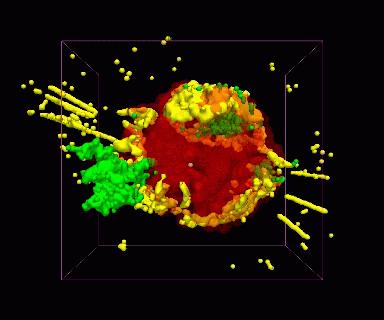
| Supernova explosions of all types are not spherical. These deviations from sphericity can be present in the shape of the supernova photosphere as a whole, in the spatial distribution of individual chemical elements within the supernova ejecta, or even in circumstellar material interacting with the supernova. We can detect the effects of asphericity in distant SNe at early times even though they are spatially unresolved from Earth by studying the polarization of light emitted from these objects. I will present recent results from optical spectropolarimetry studies of both core-collapse and thermonuclear supernovae. Essentially all core-collapse supernovae are highly aspherical in their cores, even if the outer parts of the ejecta show only small deviations from spherical symmetry, indicating that the explosion mechanism itself is highly aspherical. Type Ia supernovae, by contrast, exhibit much smaller evidence for asphericity. |
(Credit: NASA/CXC/MIT/T.Delaney et al.)