Friday, March 13, 2009, 12:00 noon, Phillips Auditorium
Extremely metal-poor stars in ultra-faint dwarf galaxies --
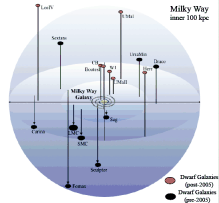
Are those dwarfs the building blocks of the Milky Way
Dr. Anna Frebel (CfA)
|
The chemical evolution of the Galaxy and the early Universe is a key
topic in modern astrophysics. The most metal-poor Galactic halo stars
are now frequently used in an attempt to reconstruct the onset of the
chemical and dynamical formation processes of the Galaxy. Principally,
the same should be possible for other systems such as dwarf spheroidal
galaxies, or even smaller, fainter systems such as the recently discovered
ultra-faint dwarf galaxies from SDSS. Until recently, no extremely
metal-poor stars (Fe/H-3) were known in any of these dwarf galaxies. I
will present new methods of obtaining Fe abundances of dwarf galaxy stars,
and along with it the discovery of an existing population of extremely
metal-poor stars in the new ultra-faint galaxies. From high-resolutions
spectra of six selected stars we find evidence that the ultra-faint dwarf
galaxy chemical signature strongly resembles that of the Milky Way halo
field stars. This lends support for the galaxy formation scenario through
hierarchical merging which predicts that small dwarf galaxies are the
building blocks of the Galaxy.
|