Wednesday, December 02, 2009, 3:00 pm, Pratt Conference Room
The Nature of Dust-Obscured Galaxies at z~2
Shane Bussmann (University of Arizona)
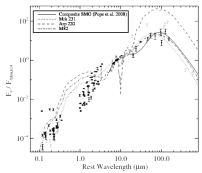
| I will discuss the nature of a population of dusty, luminous galaxies at z~2 discovered by the Spitzer Space Telescope. Application of a simple optical to mid-IR color criterion (F_24um/F_0.7um > 1000) to Spitzer wide-field surveys efficiently identifies a significant fraction of the IR-luminous z~2 population. These objects, known as dust-obscured galaxies (DOGs), may be related to sub-millimeter selected galaxies (SMGs) within an evolutionary paradigm for massive galaxies at z~2. I will present a multi-wavelength study aimed at testing this hypothesis, including results from (1) CSO 350um single dish and CARMA 1mm interferometry imaging confirming that DOGs have warmer dust than SMGs; (2) HST NICMOS imaging indicating that DOGs have more relaxed morphologies than SMGs; and (3) stellar population synthesis modeling suggesting that DOGs have higher stellar masses yet lower star-formation rates than SMGs. Within the evolutionary scenario of massive galaxies, these observations imply the mid-IR bright phase (DOGs) occurs subsequent to the sub-millimeter bright phase (SMGs). I will discuss some future directions, focusing on testing AGN feedback in massive galaxies via SMA observations of DOGs and numerical simulations of a physical model for the evolution of massive galaxies being developed in the Institute for Theory and Computation. |