Friday, October 23, 2009, Noon, Phillips Auditorium
The Dependence of Gas Richness and Disk Building on Galaxy Mass
Dr. Sheila Kannappan, University of North Carolina
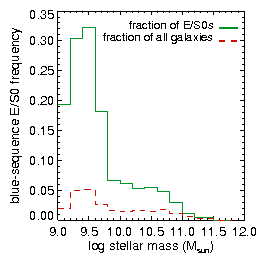
| Galaxies are known to transition from largely blue and disk-dominated to largely red and spheroid-dominated as they increase in mass across the "bimodality" scale at a stellar mass of M_* ~ 3x10^10 Msun. I will present converging lines of evidence suggesting that the beginning of this transition occurs at another mass scale of interest: a "threshold" mass at M_* ~ 5x10^9 Msun, marking shifts in both gas richness and galaxy structure. Below the threshold mass, dwarf disk morphologies and gas-to-stellar mass ratios greater than one are common. Above it, large spiral galaxies like our own emerge, surviving in a narrow mass range up to a "shutdown" scale at M_* ~ 1-2x10^11 Msun. The transformation from dwarf to large-spiral disk structure may involve a recently identified class of galaxies common at intermediate masses: "blue-sequence E/S0s," which combine compact early-type morphology with blue colors, abundant gas, and evidence of disk regrowth. Examining these and other disk-building galaxies, I will discuss observational clues to the mechanisms and timescales of disk growth. Finally, I will describe progress toward understanding disk-building processes in the context of the evolving cosmic web, a key goal of the forthcoming RESOLVE Survey. RESOLVE will perform a comprehensive census of stellar, gas, and dynamical mass as well as star formation within 53,000 cubic Mpc of the z=0 universe, enabling an unprecedented, fully integrated analysis of the co-evolution of galaxies and the larger structures in which they live. |