Friday, October 16, 2009, Noon, Phillips Auditorium
Ionized Gas in Lyman Break Analogs:
Probing extreme star-forming galaxies at high resolution
Thiago S. Gonçalves, Caltech
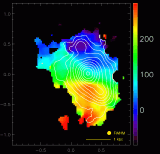
| Supercompact ultraviolet-luminous galaxies (ScUVLGs), characterized by high far-UV luminosities and surface brightnesses as detected by GALEX, are intensely star-forming objects in the low-redshift universe (z~0.2), with star formation rates reaching up to 50 times that of the Milky Way. These objects present metallicities, morphologies and other physical properties similar to higher redshift Lyman-break galaxies (LBGs), so ScUVLGs are being studied as potential local analogs to LBGs. Strong hydrogen emission lines and compact sizes make ScUVLGs ideal candidates for integral-field spectrography. ScUVLGs have been observed with Keck/OSIRIS with an AO-assisted spatial resolution of less than 200pc. We detect satellite companions, diffuse emission and velocity shear Artificially redshifting our data to z ~ 2.2 allows for a direct comparison with high-z LBGs, and we find striking similarities between them. The same physical processes may be responsible for the observed properties of star forming galaxies in the early universe. We also find a strong correlation of observable properties with stellar mass, indicating an evolutionary sequence in which galaxies settle into a colder dynamical structure while consuming the gas reservoir to form stars. |