Friday, October 9, 2009, Noon, Phillips Auditorium
Milky Way Satellites: Masses and Profiles
Dr. Matthew Walker, University of Cambridge
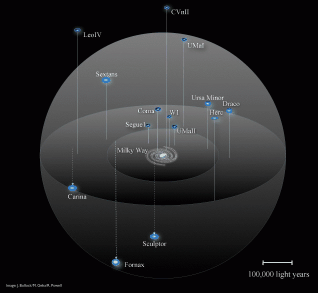
| The Miky Way's dwarf galactic satellites represent the small-scale limit of galaxy formation and offer one of our best opportunities to test the cold dark matter paradigm. I present an analysis of kinematic data for the brightest dwarf spheroidals, and show that the product of half-light radius and squared velocity dispersion provides a model-independent estimate of mass enclosed within the half-light radius. Applying this formula to the entire population of Milky Way satellites, including the ultra-faint objects found with SDSS data, I find a scaling relation of the form mass proportional to r^x, where x >~ 1.4. I discuss this result within the context of a hypothesized 'universal' mass profile. Finally, I discuss prospects for using the largest kinematic data sets to distinguish constant-density cores from the cuspy density profiles characteristic of simulated dark matter halos. |