Thursday, November 20, 2008, 12:30, Pratt Conference Room (PG-04)
Massive Stars: Life and Death
Mr. Jose Luis Prieto (Ohio State University)
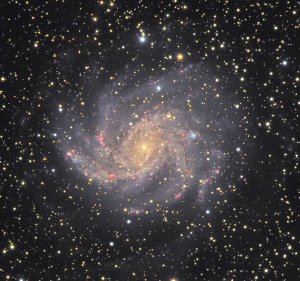
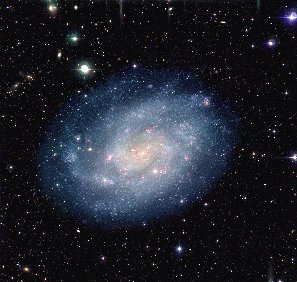
| One of the most powerful tests of stellar evolution theory for massive stars is to observationally establish the causal mapping between different populations of massive stars (e.g., red-supergiants, Wolf-Rayet stars) and their explosions (e.g., supernovae and GRBs). This connection has been firmly proven only for a handful of objects, most notably in the case of supernova 1987A in the LMC with its blue-supergiant progenitor star Sk -69 202. However, the progenitors of most supernova types have not been identified directly. I will present two supernova-like transients discovered this year in the nearby galaxies NGC 6946 and NGC 300 for which we have identified the progenitors as dust-enshrouded massive stars in Spitzer images. This new class of luminous transients has progenitors that are extremely rare compared to known massive stellar populations identified in the mid-infrared. I will discuss the implications of these findings in the context of low-mass massive stars (i.e., close to 8 Msun) and connect it to electron-capture supernovae. |