Thursday, October 30, 2008, 12:30, Pratt Conference Room (PG-04)
Imaging Stars and Hot Jupiters With Interferometry
Dr. Ming Zhao (Michigan)
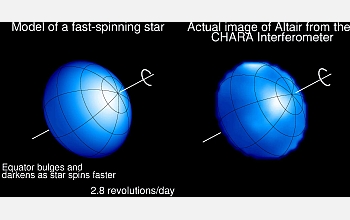
| Long baseline optical inerferometers now have the power to resolve objects as small as 0.5 milliarcseconds in the near-IR, allowing us to study stars and their environment in unprecedented detail. We first present our study on rapid rotators. As a fundamental property of stars, rotation changes stars shape, surface brightness, luminosities, and Teffs, and also modifies the observed abundances of various elements. Since most hot stars are rapid rotators, understanding the effects of rotation will shed light on critical areas of stellar evolution and basic astrophysics. Using CHARA-MIRC, we resolved the surface of Altair, resulting in the first image of a main sequence star other than the Sun. We also imaged and modeled Alp Oph and Alp Cep, allowing us to confirm the gravity darkening phenomenon and investigate the impact of their rapid rotation to their status in the H-R diagram. In addition to rapid rotators, we also obtained the first resolved images of the well-known interacting and eclipsing binary Beta Lyrae, leading to its full orbital parameters for the first time ever. Lastly, we present our efforts on direct detection of nearby hot Jupiters using precision closure phase, showing that it is feasible with CHARA-MIRC and the CHAMP fringe tracker. |