Thursday, December 14, 2006, 12:30 pm, Pratt Conference Room
Galaxies in Transition:
AGN activity and Environments of Post-Starburst Galaxies
Renbin Yan (UC Berkeley)
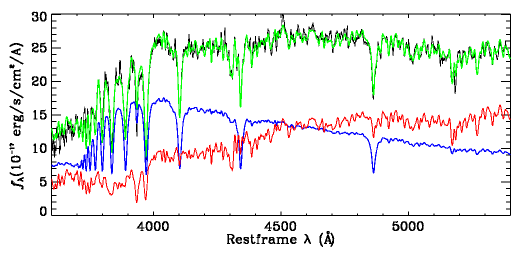
| Post-starburst (K+A) galaxies are galaxies that have had their star formation quenched recently and are on their way to become red sequence galaxies. The nature of the quenching mechanism in K+As is uncertain, but resolving it is critical to understanding the build-up of the red sequence population. With two large redshift survey datasets from SDSS (z~0.1) and DEEP2 (z~1), we have studied the K+A population at both low-z and high-z with identical methods. From the SDSS sample, we have discovered that the emission line commonly used to define K+A galaxies at high z, [OII] 3727, is heavily contaminated by LINER emission in many cases, complicating interpretation. Using selection techniques that avoid this problem, we find that at both low and high redshift, a large fraction of both red sequence and K+A galaxies have substantial [OII] and other line emission originating from AGN activity. K+A galaxies are preferentially found in underdense environments, which resembles their progenitors --- star-forming galaxies. The implications from these studies for the quenching mechanisms of star formation will be discussed. |