Thursday, November 2, 2006, Pratt Conference Room at 12:30 pm
Big and Little Pictures of M31
Dr. Pauline Barmby (CfA)
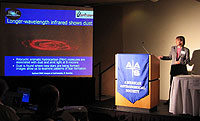
| The Andromeda galaxy, M31, has been of key importance to astronomy ever since Hubble used it to show that spiral nebulae were external galaxies. In this talk I'll present two views of M31: the first is a large mid-infrared mosaic made with the IRAC instrument on the Spitzer Space Telescope. We've used this image to measure M31's stellar mass and star formation rate, and to discover an inner ring which we believe to be the result of a head-on collision with M32. The second view of M31 is a close-up look at its most massive globular clusters with HST. Fitting structural models to these images allows us to determine their place on the "globular cluster fundamental plane", which for M31 clusters extends over nearly four decades in luminosity. I'll discuss the implications of the very tight FP correlations for both cluster and galaxy formation. |