Hectospec Observers Reference Manual

Figure 1. Hectospec focal surface.
2 What
to expect at the Telescope
3 Duties
for Hectospec Observers
4 Fitting
Fibers to Targets, XFITFIBS
4.1 Brief Instructions
4.1.1 Make a catalog
4.1.2 Run Xfitfibs
4.1.2.1 Load catalog and select Field Centers
4.1.2.2 Select Candidate Guide stars
4.1.2.3 fit fibers
4.1.2.4 submit
5.1 Initializing the
spectrograph
5.2 Kinds of ExposurES
5.2.1 Focussing
7 Quick
Look Spectral Extraction
10 APpendix
II - Observers cheat sheeT
1 Introduction
The fiber robots position 300 fibers in 300 s to an accuracy of ~25 µm. Each fiber has a core diameter of 250 µm, subtending 1.5² on the sky. Adjacent fibers can be spaced as closely as 20², but the positioning constraints are complicated due to the tube extending from the fiber button to the edge of the focal surface.
Currently we possess a 270 line mm-1 grating blazed at ~5000 Å and a 600 line mm-1 grating blazed at ~6000 Å .The efficiency curves are shown in Figures 2 and 3.
Most of the information in this document is for the benefit of the observing staff and the SAO and MMTO personnel responsible for operating the instrument. The astronomer’s duties are limited to preparing the robot configurations for observing and taking data with the bench spectrograph. MMTO and SAO staff will prepare the spectrograph for observing and will fill the dewar.
2 What to expect at the Telescope
The observer’s main responsibilities are to prepare the fields for observation with the planning software, to take data with the spectrograph, and to help replan observations during the night if conditions require a change. Observers should be familiar with the planning software and the instrument constraints described in the next few sections.
The most common error that we have encountered is poor choice of guide stars, including guide stars that are too faint or that are in fact compact galaxies. We strongly recommend guide stars brighter than R=15.5. Observers should use the preview feature in the XFITFIBS software to eliminate galaxies.
Hectospec will be operated in queue mode. Observers may therefore expect to receive a fraction of the clear observing time during each run equivalent to their fraction of allotted time during that run. We try, if at all possible, to observe some of the officially scheduled observer’s fields during their run. If observers are not prepared with valid configuration and catalog files, observations cannot be made.
Currently Nelson Caldwell is responsible for queue scheduling. Nelson attempts to review the submitted files to see if they are valid.
3 Duties for Hectospec Observers
Observer Responsibilities
1.
Run
the
spectrograph/CCD acquisition
control software
2.
Annotate
the
data logs (now under
automation), with comments on conditions, data quality, problems
encountered,
etc.
3.
Check
the
operation of the spectrograph/CCD
at the beginning of the night, and monitor readout noise, spectrograph
focus,
thermal flexure, etc. Normally, the
actual focusing would be done by the robot operators, Perry and Mike,
who would
also fill the CCD dewar.
4.
Be
knowledgeable about the fiber assignment
code "xfitfibs", in particular with regard to the restrictions on
rotator position and guide star selection, to the extent of being able
to run
the program at the telescope should the need arise.
5.
Be
knowledgeable about the normal sequence
of operating the positioner and acquiring fields, so that when problems
with acquiring a field occur, the
robot
operators can be advised as to how to proceed (e.g., moving on to
another field
because of poor guide stars). This would
not include actually operating the positioner; that task would remain
in the capable
hands of trained personnel.
6.
Do
quick look
reductions of data as it
appears, checking for overall quality, and in particular insuring that
the
spectra fulfill program goals. E.g., are objects detected at all
(coords ok?),
are objects underexposed or overexposed, etc.
7.
Help
make
decisions regarding the queue
during times of marginal weather or seeing, choosing targets from the
nightly
list. Normally, the nightly observations
are scheduled by the queue manager (Caldwell at this time).
To
aid the
on-site astronomers, each group
with Hectospec time will be expected to supply a brief summary of their
data
and calibration requirements.
4
Fitting Fibers to Targets, Running Xfitfibs
(1) The PI makes a catalog of objects, which may be ranked in preference. The catalog must also include guide stars on the same coordinate system. Guiding is done at the edge of the Hectospec field, not on the surface where the object fibers are positioned. Thus, there are very stringent requirements on guide stars by the small area of sky available and the limited range of magnitudes allowed by the TV cameras.
The 2mass and GSC II catalogs can be used where an observer catalog is minimal in stars. In that case, the program tmcguidestars should be used. This program searches the 2mass catalog for coincidences with the observer catalog, and computes a coordinate transformation. 2mass and GSC II stars are selected in the field, transformed to the observers' catalog coordinate system, and added to the catalog. Note: the target catalog must have some stars in common with the 2mass catalogs. You might need to add stars to insure that, even if you don't intend on observing them. Bad News tmcguidestars is not yet ready for export. It does run on CfA computers, in a command line mode. External projects should contact instrument scientists if they need help with guide star selection.
cfa-www.harvard.edu/~john/xfitfibs/
and runs the config program for approximate dates of observation. In this process, guide stars are checked for suitability using a number of criteria (magnitude range, not a galaxy, no neighbors, etc).
(3) xfitfibs requires information such as date and length of observation, number of exposures, ranking of config, and for Chelle observations, the filter and binning needed, all which will be used in scheduling. The output of the program is a number of files which would now be sent to a CfA computer for human checking, via the button Submit . After they are checked at CfA, the configuration files are sent to a computer at the MMT.
(4) The configuration file is modified at the telescope a few minutes before the observation takes place, in order to update positions, rotation angles, random sky selections, and guide stars.
Please submit your configuration files at least 10 days before the run starts.
4.1
Brief Instructions for
Xfitfibs
4.1.1. Make a
catalog
ra dec type
but it's probably better to have more:
ra dec object rank type mag
A sample catalog would look like:
ra dec object rank type
----------- ----------- ---------- ---- ----
0:40:30.289 41:16:08.73 008-060 1 TARGET
0:40:31.566 41:14:22.54 010-062 1 TARGET
0:54:58.594 43:05:22.298 guide
0:54:59.146 39:03:36.815 guide
Note the row with dashes (also tab delimited). "guide" indicates the guide stars, located at the end of the file. In this case, the guide stars have no rank or object name (but the tabs are there). The starbase suite of programs may be downloaded at
http://cfa-www.harvard.edu/~john/starbase/starbase.html
The command check is useful top run on your catalog to see that the format is valid (type "check < mycatalog"; no message means that the catalog is valid). The command fldtotable will convert an ascii table to starbase (see the help pages).
It is nothing short of essential that the targets and guide stars be on the same coordinate system.
4.1.2 . Run Xfitfibs
4.1.2.1 Load catalog and select field centers
- Start up program. this brings up the drawing window and the field window
- Load a file with pull down menu. This will draw the objects and a 1d circle centered on the objects' centroid, and also make 1 target center in the fld window.
- In the latter window, enter the start time in UT, e.g.: March 3 03:00:00 2005
- Enter an exptime in minutes and nexp (e.g., 15 and 3). (Leave pa,
minutes, r0, r1 and r2 alone)
- For each entry in the field table, enter a priority which will be used in the schedule.
- If you need sky offsets, please enter the number and
time in minutes per exposure. Offsets will typically be 5
arcs; successive exposures will be in different locations with the same
offset value.
- for Chelle observations, select the on-chip binning, either 1x1
or 2x3. Spec projects leave this and the filter blank.
- for Chelle observations, select the filter. Choices are Ca19, OB21, OB24, OB25, OB26, Na28, RV31, OB32, OB33, OB37, Ca41, iodine, and dumiodine. OB25 is the Halpha filter. See http://cfa-www.harvard.edu/cfa/oir/MMT/MMTI/hectospec/Filter_Specs_a.pdf
- for Spec observations, select the grating: 270 or 600. Then select the
centralwave(length). For the 270, this is always 6500. For the 600gpm
grating, you have a choice of 4800, 5300, 5800, 6300, 6800, 7300, 7800,
8300. Errors will occur upon submission if you enter invalid
numbers.
- Click on the box next to the config number (beginning of line), it should turn red indicating it is being operated on.
- In the drawing window you may now move the circle to where you want it by clicking and dragging, or enter new coords by hand. You may add fields by using the table pull down menu. When you are through moving things around, you should turn those buttons off.
- Click on parameters in
the field table window, and set
the # of sky fibers. Once you are
happy with your field centers, we need to...
4.1.2.2 select candidate guide stars
Click on Fit Guides tab,then begin fit.
The number of guide stars will appear at the far right of the fld table row. A red background means too few stars available. You may have to move the circle center or change the mag limit on the guide stars (at the peril of them not being seen at the telescope).
It may also be the case that the rotator angles are red, even though there are enough guide stars. In this case you can change those angles by clicking on "toggle guide annuli", going to the drawing window clicking on the (faint) red circle at the ends of any of the 3 annuli and dragging the annuli around until r0,r1 and r3 are green.
Next you need to classify the guide stars to remove double stars, stars that are too faint, and plain old galaxies. Click on
"classify candidate..."
After a while a message will come back with the results. Some stars may be rejected. Click on ok to rerun the guide star selection.
You can view the guide stars by bringing up the "Guide" window. Use view to elect each config in turn.
Clicking on show, will start up ds9 and display all the guide stars in different frames. Nixed stars may also be seen by using view. If you are left with no guide stars, you may try to lower the faint mag limit in the parameters menu, but please advise us that you have done so, and expect some trouble at the telescope.
4.1.2.3 Fit fibers.
Click on fit fibers, if your objects have a ranking system, then select rank, otherwise don't click on it. Make depth=7. If you are configuring for Chelle, click on that as well. Now, begin fit.
Note that all the field centers you have entered in the fld table are fit at once, such that no target is assigned more than once. If you create two different output files from the same catalog, by running xfitfibs at different times with different field centers, then you may have duplicates.
Check to see that you have fit the number of targets you expected, otherwise, change your sky fiber numbers in parameters. Ranking of targets may be changed by using the rank window. See the details in the help page.
4.1.2.4 Submit
Now you ready to submit:Click on the Send tab.
Pick the current trimester (e.g., 2005a)
Pick the PI number,
Click on send
You may get a warning about changed parameters in the field table, which I think can be ignored. A number of files are then sent to CfA, where they are checked again before being sent out to Mt Hopkins. Note that sending a config file (the one actually used at the telescope) directly to Mt Hopkins is discouraged, since such a file would not have the Program number identified, that being added during the "send" process.
Send will fail if you did not classify the guide stars. Go back and classify them, and then run Fit fibers again.
Send will fail if you did not enter a valid filter or binning for Chelle observations, or valid grating and centralwave(length) for Spec. Correct those, and press Fit fibers again. Now submit
Now you can submit.
Questions should be addressed to
hectospec at cfa.harvard.edu
or
hectochelle at cfa.harvard.edu
5 Taking Data with SPICE
5.1 Initializing the spectrograph
The Hectospec bench spectrograph has 3 motors that need to be powered up and initialized at the beginning of a run, and often at the beginning of each night as well, if power has been shut off for safety. These motors control the CCD dewar focus stage, the grating angle, and the High Speed Shutter (mounted on the fiber shoe). The CCD electronics control and the dome calibration lamps must also be powered up and initialized.
A
suite of three Linux boxes operate the robot positioner, the bench
spectrograph, and the CCD camera (several other computers do work as
well, but
will remain nameless here). The instrument rack on the 2nd
floor must be powered up as described above
- Login to lewis as
spec or chelle as the case may be. At the beginning of the run,
you must log into clark and hudson as well. One keyboard
talks to both clark and hudson - a KVM switch selects which
of these is connected to the keyboard. The switch is a
small box and is usually located near the
- Open up a
shell window
and type: go.go
- A
window called
spicespec or spicechelle should appear, as well as the comment
editor and ds9.

Figure 8. Spice Startup page. Use this to initialize software and home the three spectrograph motors. After this process is complete, return to the startup page for observing.
There
are several tabs in this menu, which can be selected as needed. For the first start of a new observing run,
select “Startup,” which is used to
initialize the spectrograph. The
sequence is: Start
Pulizzis, Start Rack (wait 2 minutes) Start Bench, Home
Bench, Start CCD, Start DomeCal.
The CCD temperature is controlled via a heater in the CCD dewar. If the CCD electronics have been off for a while, say since the previous morning, the temperature will be colder than nominal (perhaps as low as -135 °C) and thus the heater will come on for an extended period till the temperature reaches -120 °C. Thus, for critical measurements, you may wish to monitor this temperature until it reaches nominal, as shown on the Spice upper panel.
The
next tab allows configuration of the bench, e.g., changing the grating
or
grating tilt. Press "ConfigBench" at the begining of the
Hectospec run, or if you have changed either the grating or operating
wavelength. Also on this page, enter the observers’ name. The
Program ID
("Propid") and the PI values will be entered automatically when a
configuration is selected by the robot operator. For testing
purposes,
the telname may be set to "Test", the instrname may be
set to "test", or the detname may be set to "test"
or "specn". Nomally, these should be set to
"mmt_f5_adc", "hectospec" (or "hectochelle"), and
"specs". If the telescope is off however, and you want to take
some test data (darks for instance), then set the telname to "test",
lest an error occur.
The grating,
binning and/or the wavelength setting is chosen in this
tab as
well, with only the allowed choices being available in the pull down
menu. The configuration loaded by the
positioner
software limits the choices for these parameters, thus minimizing the
possibility of mistakes.

The “Standard Ops” page provides exposure control for the CCD, as well as limited control of the spectrograph and the dome lamps. The control is based on the ICE system.

Figure 9. Spice Standard Ops page for taking spectra. If the box on the lower left above the Pause button is selected, a pull down menu of observation types appears to select the exposure type.
An
exposure is taken by selecting a type of exposure from the pull-down
menu
(shown as obect1 here). Choices include “object”, “comp”
etc. The
number of exposures and the exposure time are taken from the columns to
the
right Go box (green before an exposure, red during an exposure
as shown
here). Click on Go to start an exposure. The user is
prompted for a
title. The Exposure box and queue status shows the
progress. Upon
readout completion, a beep is issued and the file is automatically
displayed
into a ds9 window (called “ds9spec”). To stop an exposure, first pause
it.
File names
will have the naming convention of TYPE.nnnn.fits, where
TYPE is
the fiber configuration name for OBJECT exposures (see above) or the
type of
exposure for all others, and nnnn is a running count number among all
types
of frames. The files are stored in directories created
automatically for each night, with the form:
SPEC/year.monthday.
E.G., SPEC/2004.0409 (If Hectochelle is in use, CHELLE
replaces
SPEC.
The rest of the tabs are described below.
5.2 Kinds of ExposureS
OBJECT: prompts for a title, opens the shutter, writes “object” as imagetype in the header.
SKYOBJECT: prompts for a title, opens the shutter, writes “skyobject” as imagetype in the header. Used for blank sky fields taken between object fields.
SKYFLAT: prompts for a title, opens the shutter, writes “skyflat” as imagetype in the header. Use this for twilight sky exposures.
COMP: prompts for a title, opens the shutter, writes “comp” as imagetype in the header. Use this for dome exposures of HeNeAr etc. Startup the dome lights with the appropriate button for HeNeAr, exposure times of about 5x300 seconds are recommended, multiple exposures are useful to eliminate cosmic rays. With the PenRay HgNeAr combination, shorter exposure times may be used (30 seconds or so).
DOMEFLAT: prompts for a title, opens the shutter, writes “domeflat” as imagetype in the header. Turn on the dome continuum lamps. For the dome continuum exposures with hectospec, an exposure time of 2 seconds is recommended. Shorter exposures may suffer from shutter vignetting, and thus would not be useful for throughput corrections, though the files should still be ok for pixel-pixel flattening.
QFOCUS: used for SPEC only. Enter the number of exposures desired, the center focus value, and the focus step between exposures. Good values for SPEC are 7, 4, and -0.04. This routine will take a sequence of exposures, at the requested sequence of focus values for the spectrograph, which can then be analyzed. Typically, one uses the dome calibration PenRay lamps for this purpose, though night sky emission lines work well also. The exposure can also be done while the mirror is covered. This program uses the grating in zero order, and the charge is moved between the exposures, thus only one file is produced. The image will have one spot per fiber, per exposure. So the image will have 300 rows of n spots, where n is the number of exposures. Bearing in mind that the in-focus images are not Gaussian but rather flat-topped, a script has been written that analyzes the data frame and produces a plot. In an iraf window, type this command: qfocus filename. A plot in gv will be produced showing image concentration as a function of focus position. Different fibers are shown as different symbols. Higher concentrations are better. Once you have determined the focus, you still must set it using the Focus tab.
FOCUS: used for CHELLE. nter the number of exposures desired, the starting focus value, and the focus step between exposures. This routine will take a sequence of frames, at the requested sequence of focus values for the spectrograph. Typically, one uses the dome calibration HeNeAr or ThAr lamps for this purpose, though night sky emission lines work well also. FOR CHELLE : the step should be -0.05, exposures 120s, and take 7 of them The program FOCUS.sh N, will extract information from the most recent N focus exposures To run this, type ./FOCUS.sh in a terminal window (not in iraf). Another program will display the focus files in tiled images on ds9. In this case, type display_focus N.
DARK: prompts for a title, does not open the shutter, writes “dark” as imagetype in the header. There are light leaks around the shutter, so darks should be taken with the chamber lights off. The dark rate is extremely low, and in normal circumstances does not need to be measured. Be aware that the fluorescent lights in the spectrograph room will elevate the dark count significantly for about an hour after they are turned off.
BIAS: prompts for a title, leaves shutter closed, writes “zero” as imagetype in the header. There is some structure to the bias, so we recommend taking a handful of these at the beginning of the night.
5.3 SPICE DETAILS
The autoops tab is
not
described here.
The focus tab is used after determining a new focus. Enter the
correct
value next to new focus, click on apply and set.

The next tab shows the calibration
lamp
status. The lamps themselves are usually controlled in the
standard ops
tab, but this tab shows the details of eack kind of lamp.

The start/stop tab allows control of the many software servers in the system. Select the action wanted at the middle right ("restart, start, stop"), then click on the button desired to the left (e.g., domecal up).

The shutdown page allows one to shut down the spectrograph and wide field corrector. Normally done by the robot operators.

5.4 Data Logging
The
comment window is used to create and maintain the data logs,
which are
mostly automatic. The one thing the observer can add is a comment
when needed.
In particular, it useful to comment on the seeing and cloud presence
during the
night, and any problems with particular files. To do so, first insure
that the
correct data has been selected (recall that we use the UT date). To
comment on
an existing file, click on its name in the right panel. The basic
information
will appear to the right, and you can now type into the comments
panel.
Click on Save Changes. To edit an ongoing exposure,
click on
Open Current and then enter comments. To view
the data
logs, click
on the sunburst button at the bottom right. A postscript file is
created and
the displayed using gv. Exit gv using q. Very lengthy comments will be truncated. Type what you
need, display the result, and if necessary, move the excess
verbiage to the comments for the next exposure. Copies of these
logs may be viewed by non-attendant astronomers at arond noon EDT at this
web site.

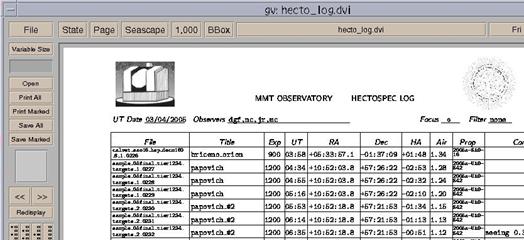
Figure 12 Example data log.
5.5 Data forMat
The A/D converter is 16 bit, so saturation occurs at 65536. There are 2 amplifiers per CCD, and thus the data are stored in FITS extension format, with 5 extensions (0 being the main file header). Among other things, this means that in iraf, you will occasionally have to refer to the file as filename[1] or [2], say when using imheader (though not imexamine).
The data from the different amplifiers are not flipped to the same orientation before writing to disk, but the header keywords allow ds9 to display the files correctly. We hope that all the file keywords are correct, and that programs like IRAF’s mscred will work, but we can’t guarantee this at this time. The SAO version of NOAO’s mscdb package must be installed to use mscred.
As already written, the data files are
stored in
directories
of the format /SPEC/ year.monthday (or
CHELLE/ year.monthday . The files are
also archived both on the local computer as well as back in
The fiber mapping files (“filename_map”) are stored along with the data files. This information is also stored in the FITS file.
5.6 DS9 BASICS
Each new file is automatically displayed into the active frame of ds9 (named spec9 here to avoid conflicts with other ds9 programs that may be running). To load files off the disk, select FILE:OPEN OTHER: OPEN MOSAIC IRAF, and then find your directory and filename. You may load files into different frames via creating a new frame: FRAME:NEW. Run through frames via Tab. Do not use mscdisplay in IRAF.
The contrast can be changed with the right mouse button. For further contrast levels, select Scale:Scale Parameters from the top bar menu. You’ll get a histogram of the data – high and low values may be selected by moving the red and green vertical lines with the mouse.
Note that the files are shown with blue on the left, thus requiring the XY coordinate system to be non-standard. Image coordinates refer to individual extensions (one per amplifier), and thus start over when crossing into an new extension, while the detector coordinates refer to the combined image. The default display also excludes the overscan areas. To see these, select SCALE and turn off DATASEC. However, some of the overscans will display over that from the next image extension…
Imexamine works as is with these files; there is no need to use mscexamine. Make sure you start up IRAFin a xgterm window.
6 Data Reduction
The data obtained by CfA PIs will be reduced by the Telescope Data Center (TDC) unless the spectrograph operation mode is inconsistent with the standard pipeline or unless the PI wishes to reduce his or her data. For non-CfA users the TDC will make the pipeline software available. Check the TDC website (http://tdc-www.harvard.edu/ ) to download this software. Doug Mink (dmink at cfa.harvard.edu) may be able to provide advice about this software in case of difficulty. Nelson Caldwell is very familiar with the operation and characteristics of the spectrograph, and has a good deal of experience with data reduction. He is willing to provide a limited amount of help to users; he may be contacted at caldwell at cfa.harvard.edu".
All Hectospec or Hectochelle data will be archived nightly by the TDC.
7 Quick Look Spectral Extraction
A
fairly
fast
method of extracting all 300
fiber spectra from Hectospec images (or 240 spectra for CHELLE data) is
provided
by a command that runs a series of PERL and IRAF scripts. The input is
a series
of raw images, which are processed as described in this document
<http://cfa-www.harvard.edu/oir/MMT/MMTI/hectospec/hecto-reductions.htm>.
The calibration files used are stored in a subdirectory, and may need
to be
remade for every observing run (but not every night). The output is a
FITS file
containing wavelength calibrated, sky-subtracted spectra in multispec
format
(for CHELLE no wavelength calibration or sky subtraction is done)..
The
program currently runs on lewis.
Here
is what you need to do:
1. Open an xgterm , with xgterm
&. You may resize the font via
shift-middle mouse
button. Start up IRAF with cl.
2.
You'll
need to know the names of the files you want to combine. The IRAF
command
ldata will list the files in the current data directory, or you
can look
at the data logs. The output files will be written in
the
current directory.
3.
For
multiple files, the program detects the cosmic rays by comparing
images,
and interpolates across them in individual frames, The frames are
then
averaged together before extraction begins. For a single
exposure,
the cosmic rays will not be deleted.
4.
In
the IRAF window, you would type :
qspec
file1,file2,file3
where
the files are of the form listed from the
data command, e.g., halostar9:30pm_1.1121.fits.
The
.fits extension is
unnecessary. The
files must be separated by commas with no spaces. Alternatively,
one may reduce the most recent
file or files via:
qspec
lastN
where
N is optional or the number of files of the
same object you want to combine.
Finally, you can extract older spectra via a command like:
qspec
file1,file2
“2006.1010”
which
would extract and combine files file1 and
file2 from the 2006.1010 directory.
5.
The
program takes 1-3 minutes. The files used in the process are then
listed,
along with the names of the output files. If the output file existed
already,
the program will prompt for deletion.
6.
To look at the
spectra, use splot (you may
need to load imred and then specred first, though they are supposed to
be
loaded automatically). To run through the spectra one by one, use the (
and ) keys. The X and Y scales have been
fixed to display low signal spectra well; to scale to the entire range
of the
spectum, type w and then a while viewing a spectrum. To
smooth,
type s.
7.
At
the
beginning of each Hectospec run, and certainly if the fiber shoe has
been moved
from Chelle to Spec, a crude wavelength adjustment must be made. Inspect the extracted spectra which have not
been skysubtracted from any of your images.
Using splot, determine the wavelength of the brightest night sky
line
whose wavelength is supposed to be 5577A (but which may be off a little
because
of the problem we are about to fix).
Subtract the measured wavelength from 5577 (i.e.,
5577-wave_observed).
In Spice, select the configure tab, and locate the quick
look
wavelength offset window. Note the wavelength offset in this window,
and add
the offset you just determined to the existing value. Click on save. Now rerun the extraction. The skysubtraction
should work properly now.
Trouble
may ensue if there are no sky fibers in apertures 1-150 or 151-300.
A
ds9 regions file can be brought up to identify all the apertures and
which
fibers they correspond to. Click on regions, and load regions, and
select the
file /h/spec/specaps.reg.
8. Grating Choices
We currently have available a 270 groove/mm grating blazed at 5200 Å, and a 600 gpm grating blazed at 6000 Å, both purchased from David Richardson Grating Laboratory. The spectral coverage, spectral resolution, anamorphic magnification, grating angles and RMS image diameters for these gratings and as well as a possible 1200 gpm grating, all set up with Ha as the central wavelength, are shown below. The spectral coverages in this table refer to the nominal 3400 pixel format. However, the image quality holds up quite well over the whole 4608 pixel format, and the full spectral coverage is ~1.35 times that shown in the table. Remember that second order contamination may be an issue for some applications. Currently, we do not have order blocking filters. The spectral resolutions quoted are as measured with arc lines, with the first number referring to wavelengths around 4500 Å, while the second refers to 7000 Å.
|
Ruling Density (gpm) |
Spectral Coverage (Å) |
Spectral Resolution (FWHM Å) |
Anamorph. Mag. |
Angle of Incidence |
Angle of Diffraction |
RMS Image Diameter (pixels) |
|
270 |
4488-8664 |
5.8-5.0 |
1.06 |
22.83 |
12.17 |
1.3-1.8 |
|
600 |
5609-7522 |
2.2-1.9 |
1.14 |
29.41 |
5.59 |
1.3-1.8 |

Figure 15. The efficiency of the 270 line grating

Figure 16. The efficiency of the 600 line grating.
9 Spectrograph Performance
9.1 Calculated Throughput
The Hectospec optical layout is simple enough that very high throughput can be achieved if good reflective coatings are used on the mirrors (2 surfaces) and good antireflection coatings are used on the lenses (6 fused silica surfaces). We have used the same dielectrically-enhanced silver reflective coatings and Sol-gel antireflection coatings that we used in the efficient FAST spectrograph. Our predictions for Hectospec's overall throughput with the 270 line grating are shown below. The column labeled “Add. Fiber Losses” includes FRD, end reflection losses, and the losses from misalignments of the fiber axis with respect to the chief ray at the f/5 focal surface. This table does not include aperture losses at the fiber input, which will depend on the seeing and the quality of the astrometry of the targets and the guide stars.
|
Wave |
Mirror Refl. (2 surf) |
Lens Thrput (6 surf) |
Fiber Thrput (26 m) |
Add. Fiber Losses |
CCD Effic. |
|
Grat Effic. |
Tele Refl + 10 cor surf) |
Final Throughput, Hectospec plus Telescope Optics |
|
3650 |
0.90 |
0.89 |
0.70 |
0.80 |
0.66 |
0.80 |
0.37 |
.66 |
0.06 |
|
4000 |
0.90 |
0.92 |
0.80 |
0.80 |
0.80 |
0.80 |
0.49 |
.70 |
0.12 |
|
5000 |
0.91 |
0.98 |
0.90 |
0.80 |
0.85 |
0.80 |
0.66 |
.79 |
0.23 |
|
6000 |
0.92 |
0.98 |
0.94 |
0.80 |
0.80 |
0.80 |
0.61 |
.79 |
0.21 |
|
7000 |
0.92 |
0.98 |
0.96 |
0.80 |
0.75 |
0.80 |
0.53 |
.75 |
0.17 |
|
8000 |
0.92 |
0.95 |
0.98 |
0.80 |
0.60 |
0.80 |
0.43 |
.66 |
0.09 |
|
9000 |
0.92 |
0.91 |
0.98 |
0.80 |
0.30 |
0.80 |
0.37 |
.65 |
0.04 |
9.2 MeaSured Performance
We can compare the throughput predictions with measurements of a spectrophotometric flux standard star BD+284211 in 1″ seeing. BD+284211 was stepped across a fiber entrance aperture to find the position where we detected the maximum flux.
For an apples to apples comparison we need to correct the measurement for the aperture loss.

Figure
17. Measured throughput in 1″ seeing not
corrected for aperture losses.
The appropriate aperture correction for the plots above (measured with Megacam images) is about 1.7 (ratio of flux within a 20″ diameter aperture to the flux within a 1.5″ diameter aperture). Therefore, the peak throughput for light that hits the fiber aperture is about 17% (to be compared with the prediction of 23%) . If we average over wavelength, the measured throughput is about 75% to 80% of the predicted numbers.
We present two “real-world” performance plots: the SNR pixel-1 for a 45 minute exposure as a function of aperture magnitude, and the absorption line SNR (1+R) for 45 minutes of exposure as a function of aperture magnitude.

Figure 18. The signal-to-noise ratio per pixel for a 45 minute exposure as a function of aperture magnitude (1² diameter aperture.) The SNR per pixel is ~26 at R=21. The relations for 4500 Å and 8500 Å have the similar slopes, but show a SNR per pixel of ~9 at an aperture magnitude of R=21 for the same exposure length. Improvements in sky subtraction techniques may allow improvement at 8500 Å . Analysis and plot courtesy of Daniel Eisenstein.

Figure 19. The absorption line cross-correlation signal-to-noise ratio ~(1+R) for 45 minutes of exposure as function of R aperture magnitude (2.6² diameter aperture). All of the 1974 galaxies in this plot had reliable redshifts. The SNR ratio shown here is reduced somewhat by the use of templates from the FAST spectrograph. Better cross-correlation templates will be created. Courtesy of Michael Kurtz.
10 APpendix II - Observers cheat sheeT
This list is meant for the attending astronomers.
If the equipment is all ready, or if the run is underway, skip to item 8.
- Login to lewis as spec or chelle. Have the robot operator login to clark and hudson as well. In an xterm on lewis , type go.go
- When the spice window is up, select the startup tab, and press Start Pulizzis (wait about 10 seconds)
- then
Start Rack (wait 2 minutes).
- then Start Bench (wait about 30 seconds),
- then Home Bench (wait about a minute),
- then Start CCD, and finally
- Start DomeCal.
- Now go to the Configure tab, enter the observers' names, select the correct telname (mmt_f5_adc), the correct instrument ("hectospec" or "hectochelle"), and the correct detector ("specs").
- Insure the binning and grating are correct.
- At the start of the run, if a grating has been changed, or if a new order has been selected, press ConfigBench, and wait about 10 seconds.
- Insure that the CCD temperature are within 0.1 degree of -120 (for spec, the right temperature readout is broken). If not call an expert.
- Go to the StandardOps tab. Select bias for the exposure type, and take 3-4 frames. Inspect these on ds9, and insure there is no pattern noise. The first image or two may be saturated - ignore these.
- Take
a 300s dark exposure, 2 or three
if there is time. Use iraf implot to inspect these for
excess counts. A line plot where several hundred lines have been
averaged is the best way (e.g., implot filesname.fits[im2], then
:l 4000 4200, that's letter l, not number 1). The pixels beyond 1075 are overscan. The dark level should not be more than about 0.6 counts above the overscan in 300seconds. If it is, call an expert. - Have the robot operator configure the fibers to the calibration setup. Have the telescope operator open the mirror covers.
- Select qfocus. Turn on the penray lamps, set the starting focus to the current value, and the exposure time to 2 seconds, and take an exposure (note: this can be done with the mirror cover on). When the exposure is over, go to the iraf window, and type qfocus filename. Inspect the graph for the best focus. If there is a change, go to the Focus tab, and enter that value as a New Focus. Press apply and save. Now select the Config tab. Press ConfigureBench. If the focus hasn't changed, skip all this. Turn off the Penray lamps,
- In the StandardOps tab, select domeflats. Turn on the continuum lamps, and take 10 exposures of 2 seconds.
- Now turn off the continuum lamps, and select comps. Turn on the HeNeAr lamps and take 5 300s exposures. Turn off the lamps when finished.
- If you are able to open the telescope at sunset, start taking skyflats as soon as possible, beginning with 2 s exposures. The robot operator will move the telescope in between exposures. 5 of these are sufficient - do not take so many that you are delayed in acquiring the first field.
- Bring up the spreadsheet, by typing soffice spec_?.sxc. Locate tonight's schedule, and advise the robot operator of the first configuration. Review the program information that is located in the spreadsheet.
- During the night, monitor the time and try to keep to the schedule. Enter comments in to the logs about the conditions (seeing and clouds) and problems. Run qspec on data often to insure data quality.