


For diffuse to moderately dense plasmas, the Opacity Project includes extensive calculations of atomic data required for opacity determination, particularly Stark broadening constants for atomic and ionic lines involving relatively low excited states. These data are very precise, and approximate formula are available for transitions involving higher excited states.
Approximative methods (g method, semiclassical perturbative theory) have been used extensively to provide broadening parameters with a mean accuracy better than 30 percent for a large number of lines. Some results are only available in electronic form via an anonymous ftp to the CDS center (see the Editorial in A&AS, Vol. 103, No. 1). Furthermore, much work of high quality has been done experimentally.
Table 1 presents results for many transitions; the numbers refer to the reference list.
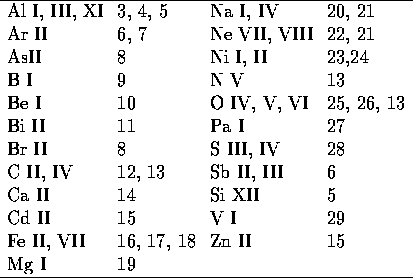
Table: Important Literature References
Results for isoelectronic sequences, such as B-sequence (9), or series four and five times
charged ion lines (30) are of particular interest. Because of the speed with
which such calculations can be made, it
would be interesting that more systematic work be done and presented as a data base. A
complementary
direction concerns investigations of systematic trends of Stark broadening parameters.
Regularities of these parameters have been investigated (31). Finally, one should mention an
important work
on the Stark broadening theory of solar Rydberg lines (32,33) and an interesting study of the
profile of the P line of H from the line center to the far wings under the physical
conditions of stellar
atmospheres (34).
line of H from the line center to the far wings under the physical
conditions of stellar
atmospheres (34).